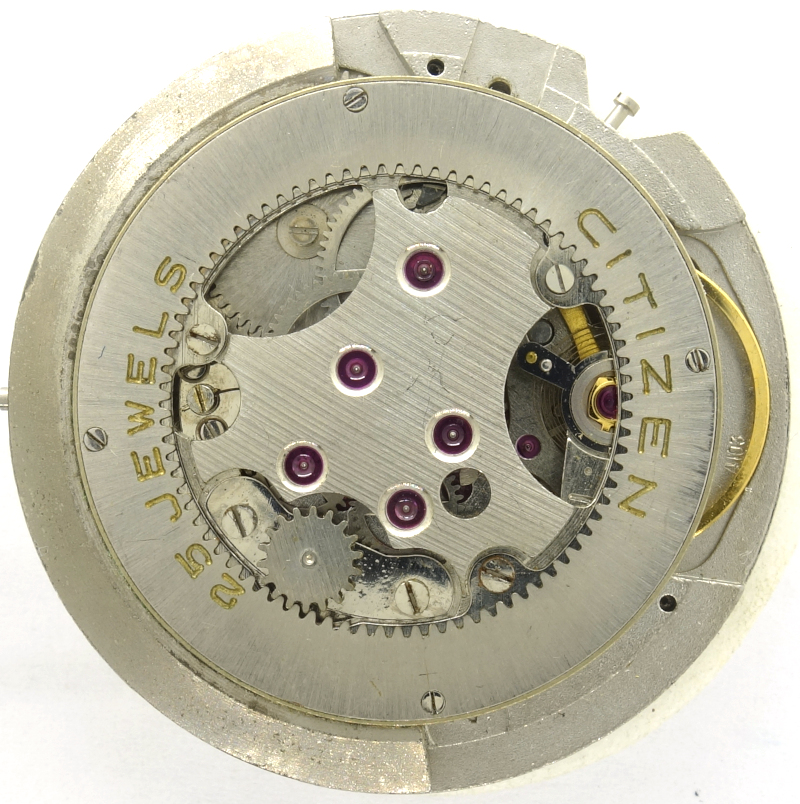
Citizen 4103
Description
One of Citizen’s largest automatic movements is the japanese 13-ligne caliber Citizen 4103, an early selfwinding caliber from the 1960s, which cannot easily conceal its structural similarity to the Swiss FHF 65, which, unlike the Citizen movement, was not particularly successful.
The movement’s unique feature lies in its self-winding mechanism, which uses an external ring rotor.
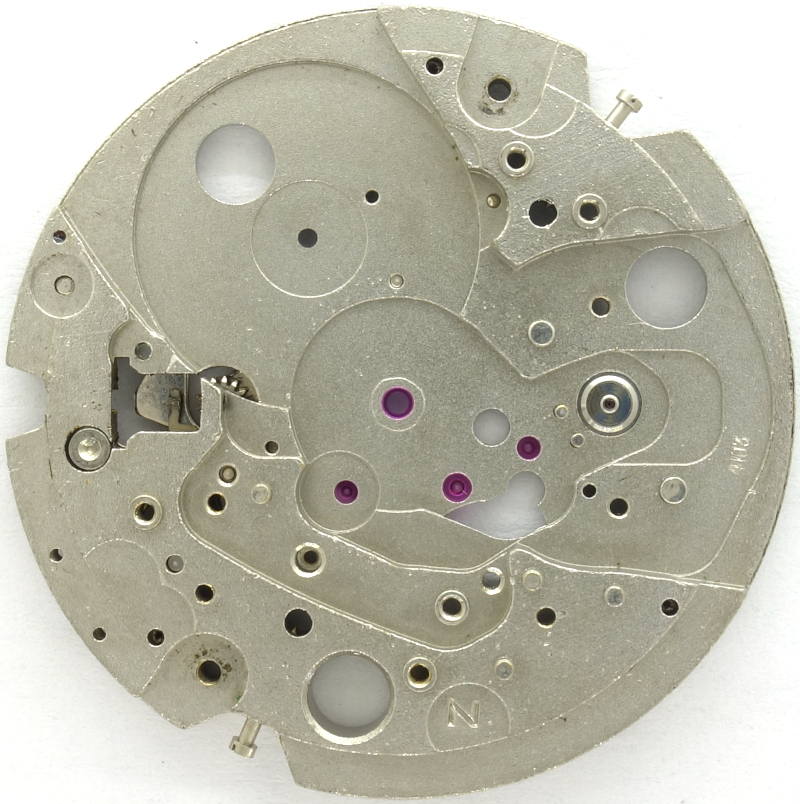
base plate
The bare base plate doesn’t reveal any special features, apart from the fact that even the minute wheel is jewel-beared. Only the relatively deep crown winding mechanism is conspicuous, as are the two protruding screws used to secure the deep dial feet.
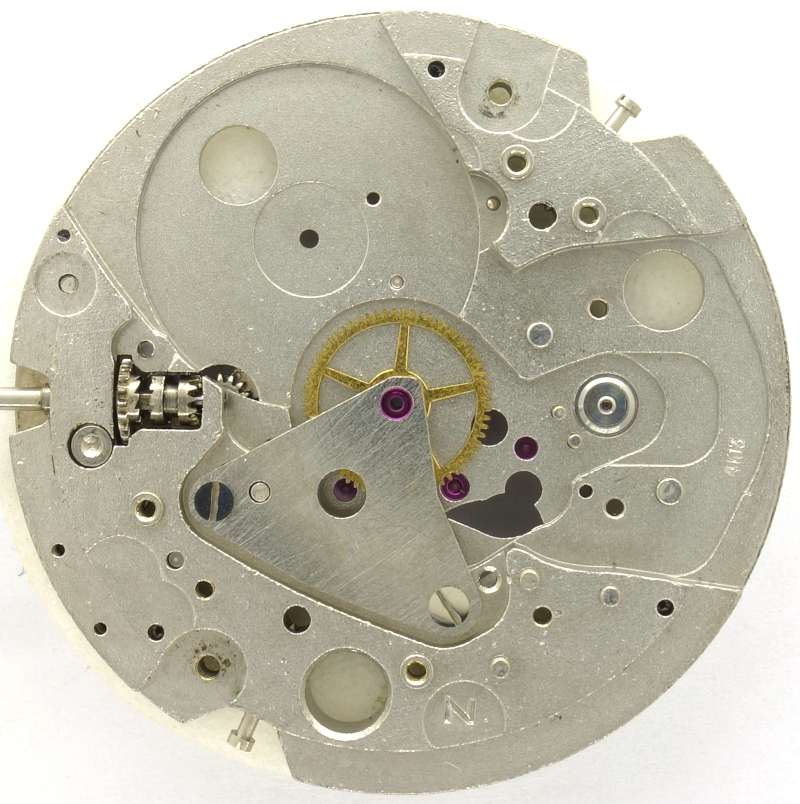
base plate with center minute wheel
The Citizen 4103 uses the classic gear train design, with the large mainspring barrel directly driving the central minute wheel, which is mounted under its own cock. Its attachment even uses two screws!
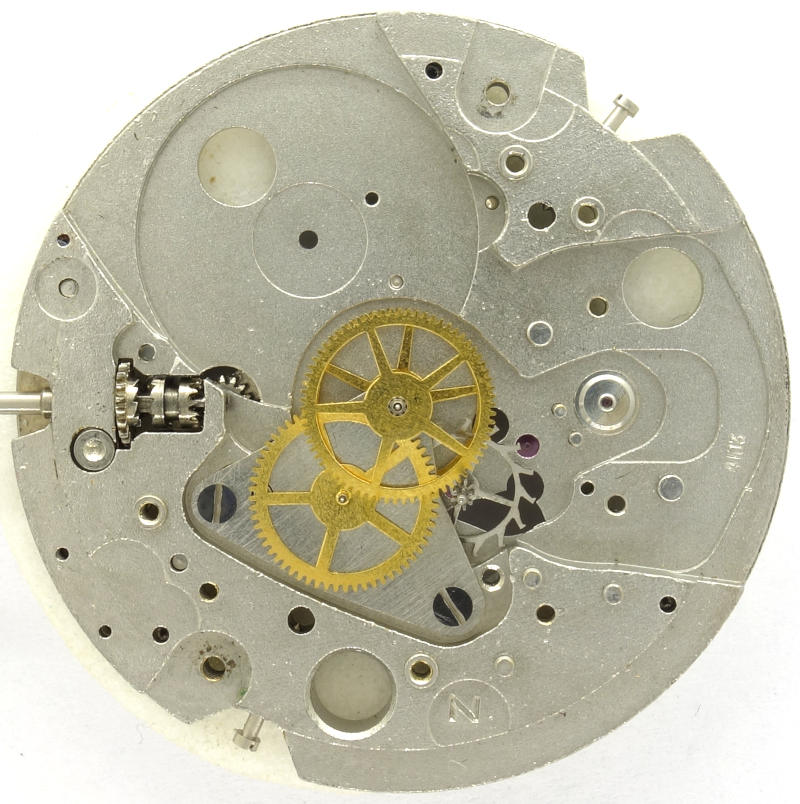
gear train
The rest of the gear train is of a conventional design, with a third wheel, a directly driven central seconds wheel, and an escape wheel, which engages the pallet lever escapement.
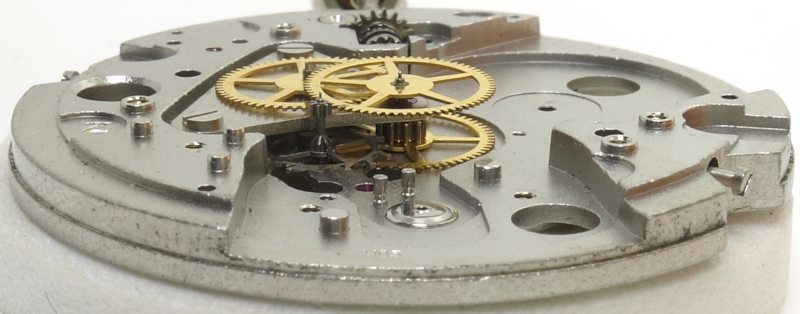
side view of the gear train
The regulator is an anular, two-leg Glucydur annular balance, state-of-the-art at the time.
It still beats slowly with 18,000 A/h, can only be adjusted directly using the hairspring key, and is housed in two in-house Parashock shock absorbers.
It is very old-fashioned that the hairspring stud carrier is not yet movable, but is part of the balance cock. In the 1960s, this was actually no longer state-of-the-art.
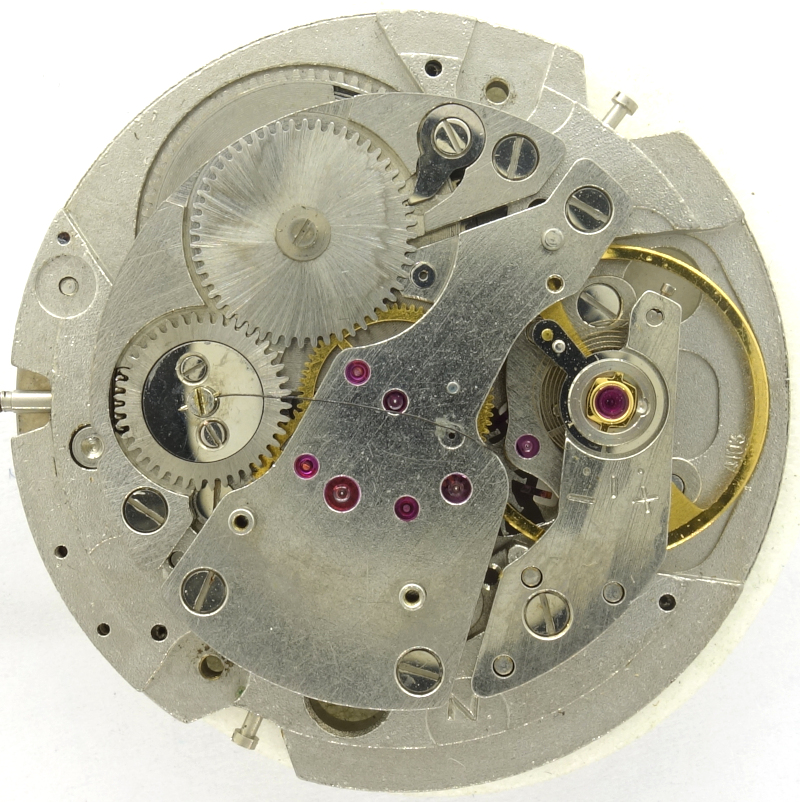
w/o selfwinding mechanism
When the gear train bridge is mounted, the three ruby and two metal bearings for the automatic winding mechanism are clearly visible. The long spring extending from the center of the crown wheel acts on the pawl of the automatic winding mechanism.
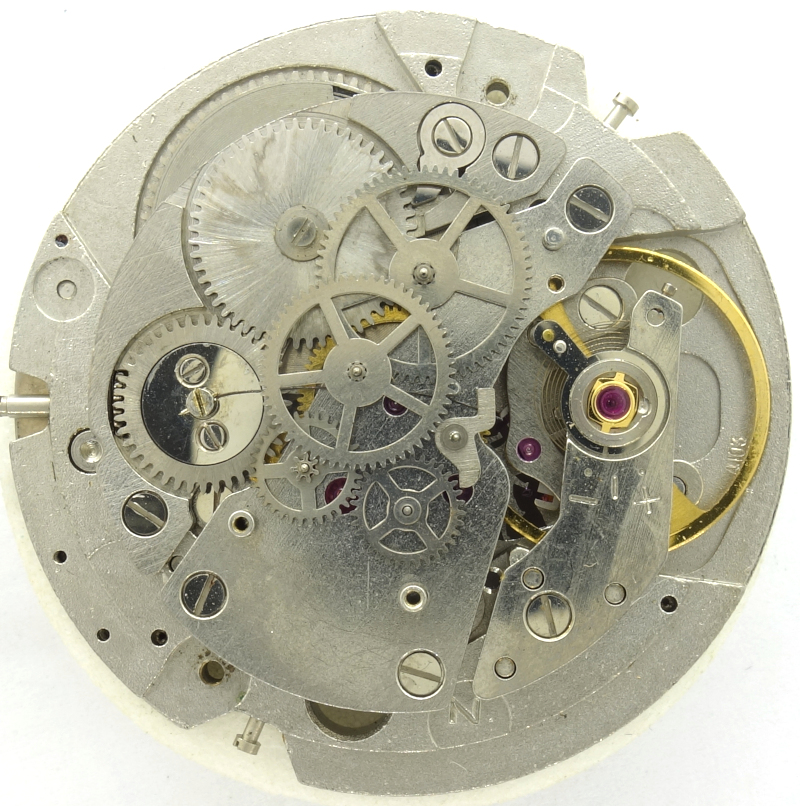
selfwinding gear train
The self-winding mechanism consists of two intermeshing wheels, with the right wheel being prevented from rotating counterclockwise by a pawl. Depending on the direction of rotation of the rotor, it engages the left or right wheel via a transmission wheel, with the result that the two subsequent reduction wheels always rotate in the same direction, regardless of the rotor’s rotation.
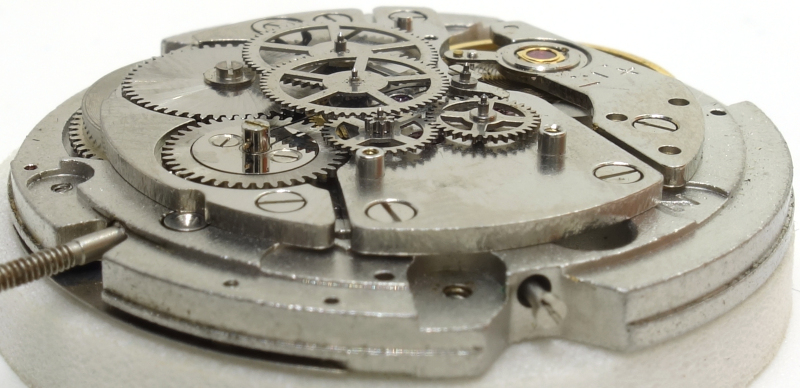
side view of the automatic mechanism
Unlike the gear train, the automatic mechanism uses a pillar construction.
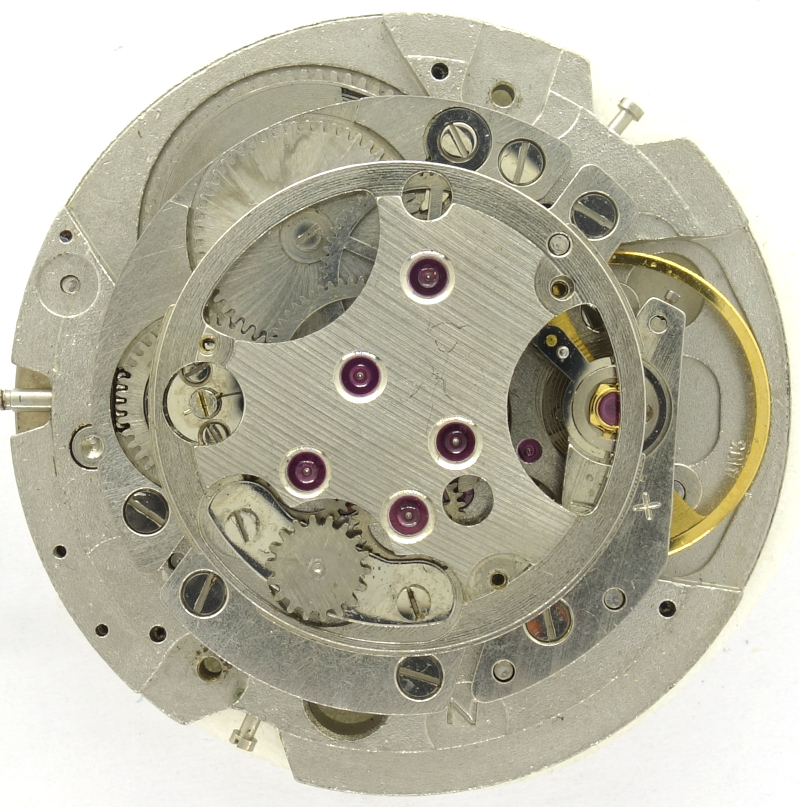
movement w/o ring rotor
All four wheels of the automatic movement, and even the pawl, are beared in rubies on the visible side of the movement. On the hidden underside, only metal bearings were used for the final reduction wheel and the pawl, a bit of a cheat.
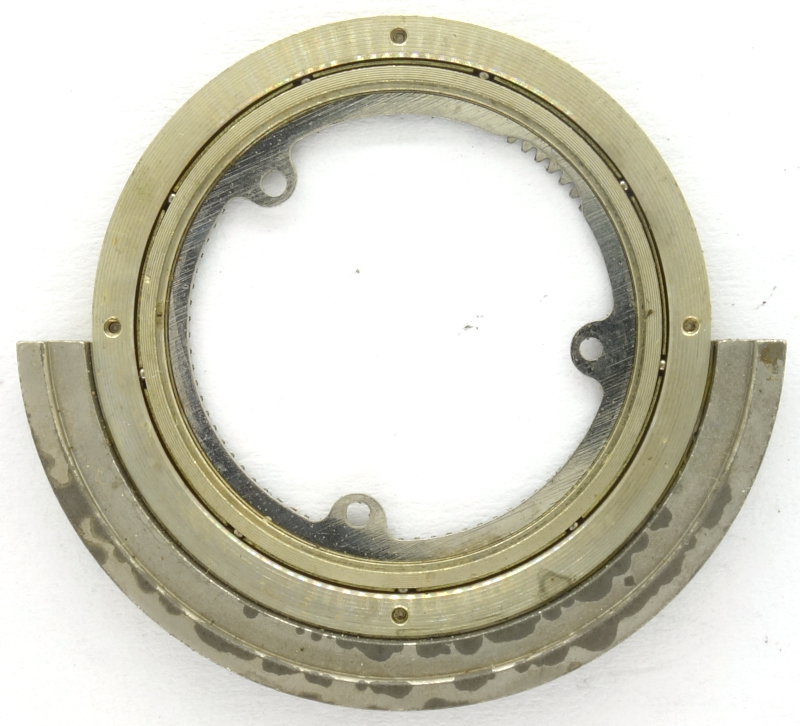
ring rotor
The ring rotor runs in a nine-ball ball bearing and is attached to the automatic bridge with three screws. Here you can clearly see the small cutout into which the floating transmission gear fits.
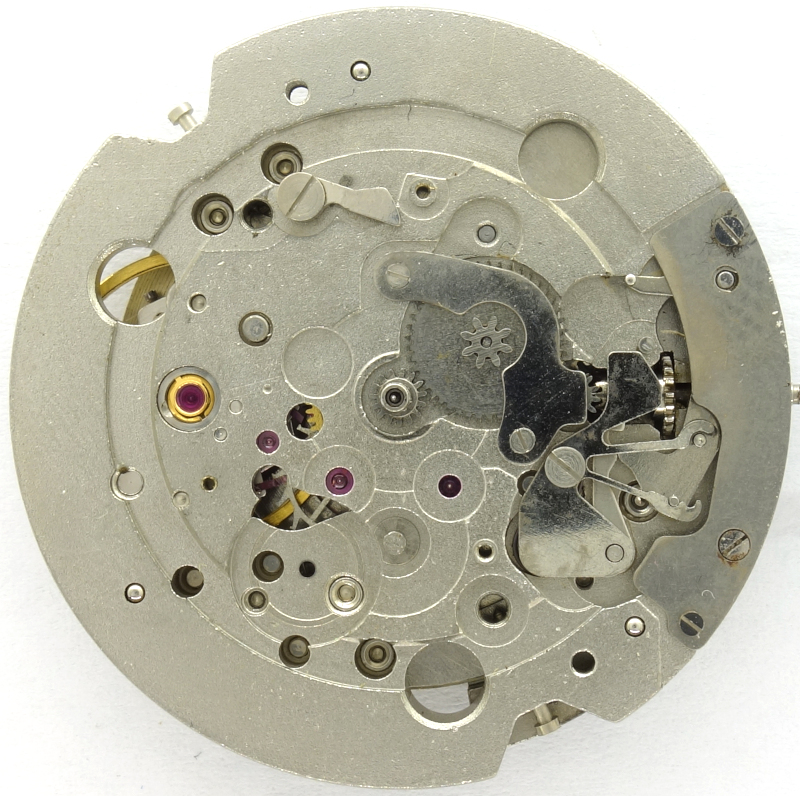
yet empty dial side
On the still largely empty dial side, you can see a lever at 2 o’clock. This ensures that when the crown is pulled beyond the hand-setting position, the date ring advances one position – a very modern and efficient way of a date quickset mechanism.
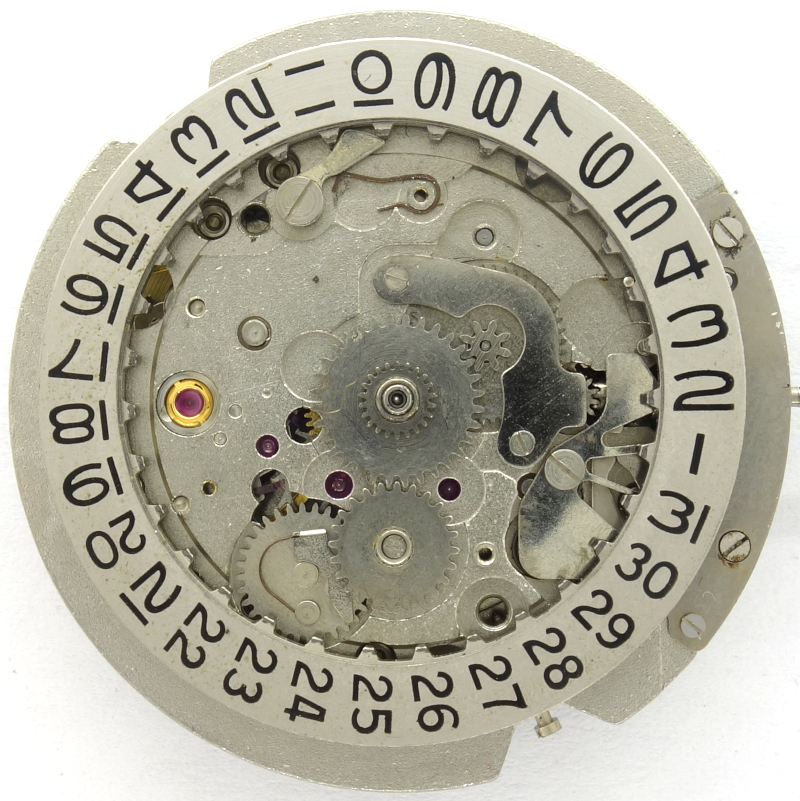
open calendar mechanism
The actual date mechanism of the Citizem 4103 follows the usual standards. It ensures that the date advances slowly and that the date does not change backward when manually adjusted via the crown or when turning the time back past midnight.
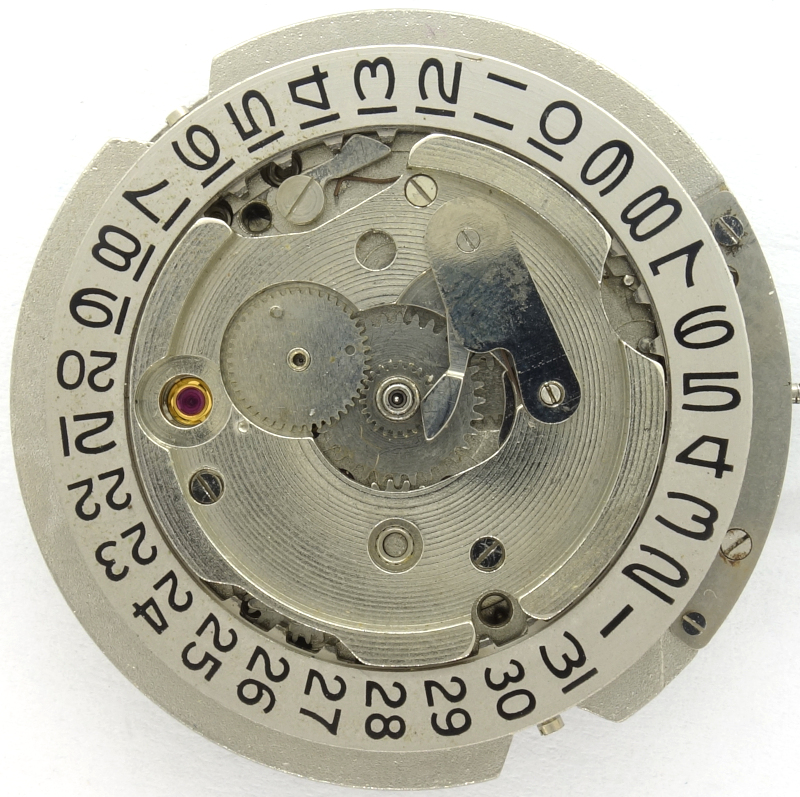
w/o weekday disc
A second 24-hour gear with a small pinion is used for the weekday indication. This engages with the star-shaped toothing on the underside of the weekday disc and advances it one position per day.
When turning back past midnight, the day of the week is not set backward, so a kind of quick adjustment is possible here as well.
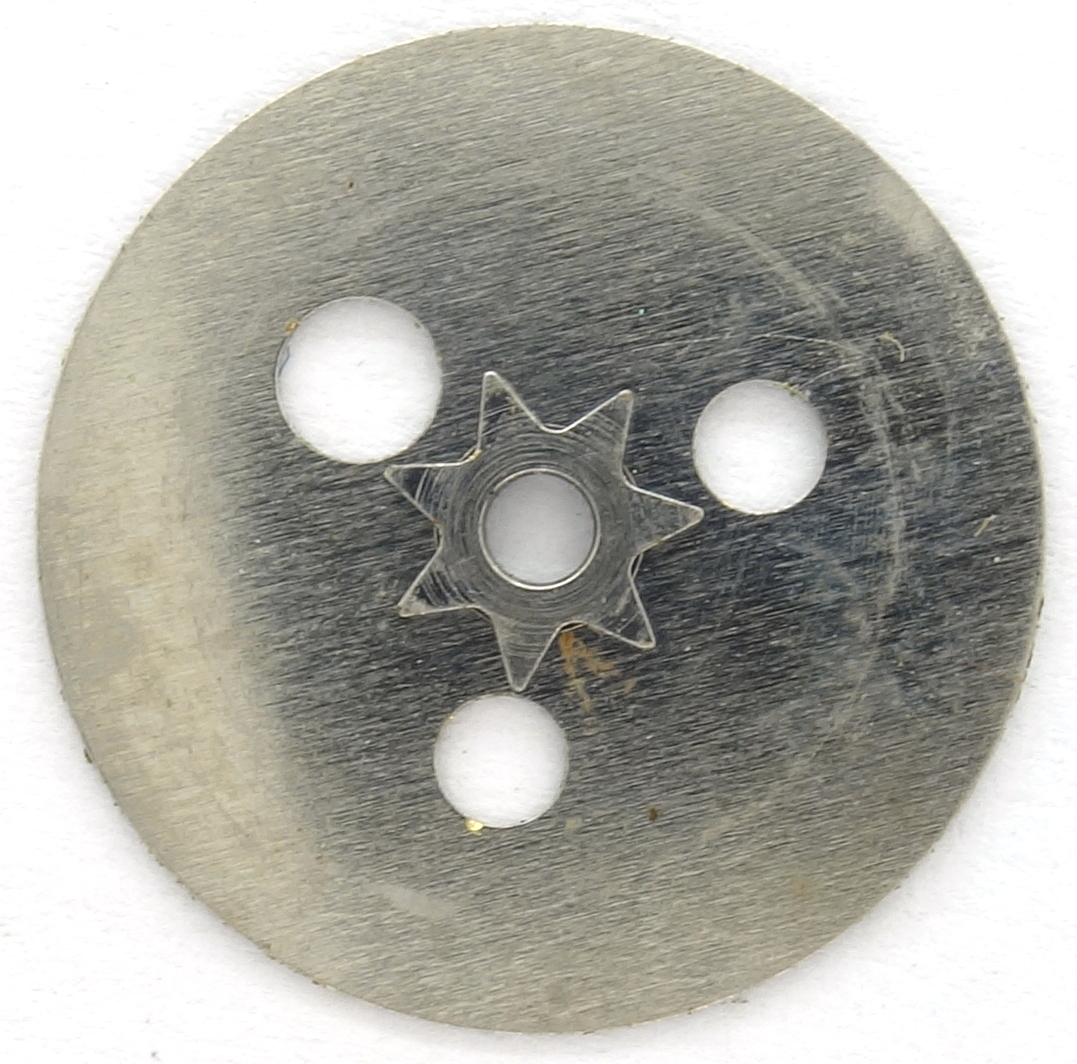
Bottom of the weekday disc
Typical for this Citizen movement is that the day of the week is displayed horizontally at 12 o’clock.
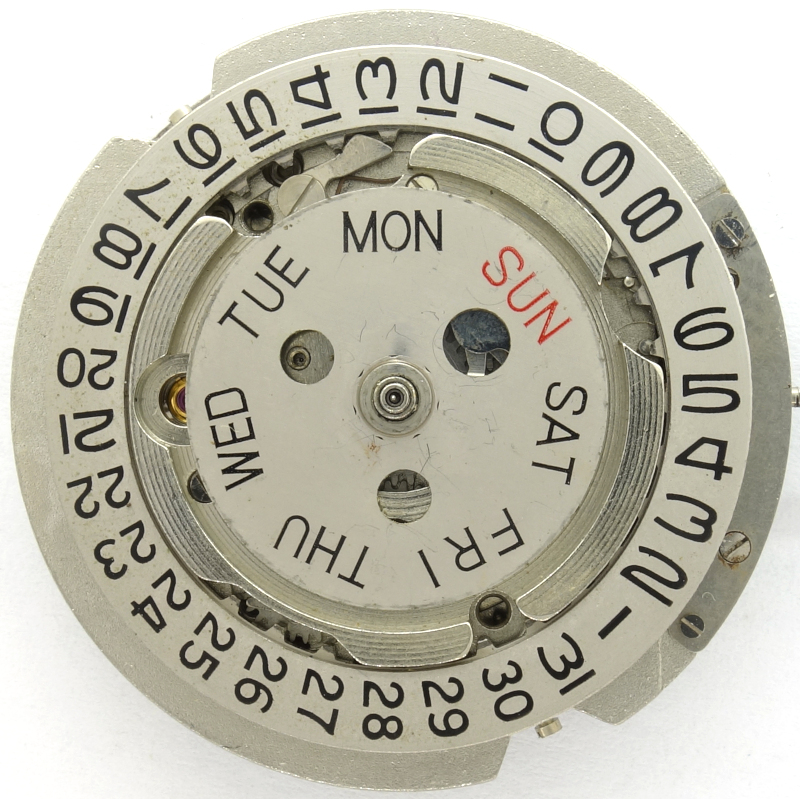
Citizen 4103: Dial side
In the lab
Although this example is complete, it exhibits problems in almost every conceivable area, which may be inherent in the system. For example, the rotor’s ball bearing is now severely worn, and the rotor has corresponding play and generates noise.
The setting lever is only inserted, not screwed, which means that the crown can be completely removed from the movement by pulling too hard, as is necessary for date correction.
Furthermore, the date mechanism suffers from a loose rivet connection on the transmission wheel between the hour wheel and the column wheel. The pin of the 24-hour wheel for the day of the week is bent, and the previous watchmaker accomplished the rare feat of incorrectly placing and swapping almost every screw, even losing screws (day of the week column wheel).
Since the balance spring is also loose, which is very unusual, it was not possible to obtain results on the timegrapher.
Technical data
| Manufacturer: | Citizen |
| Caliber: | 4103 |
| Size: | 13''' (measured: 29,3mm) |
| A/h: | 18000 |
| Number of jewels: | 25 |
| Escapement: | Pallet lever |
| Balance types: | Glucydur anular balance (two legs) |
| Shock protection(s): | Parashock (Citizen) |
| Balance bearing / direction hairspring: | Counterclockwise |
| Moveable stud: | no |
| Adjust mechanism: | Hairspring key |
| Construction: |
|
| Construction type: | solid construction |
| Winding mechanism: | yoke winding system |
| Setting lever spring: | 2 holes |
| Attachment of setting lever: | plugged |
| Features: |
|
| Production years: | 1964-???? |
| References: | Flume: K3 264 |
| Inventory number: | 24032 |
Usage gallery
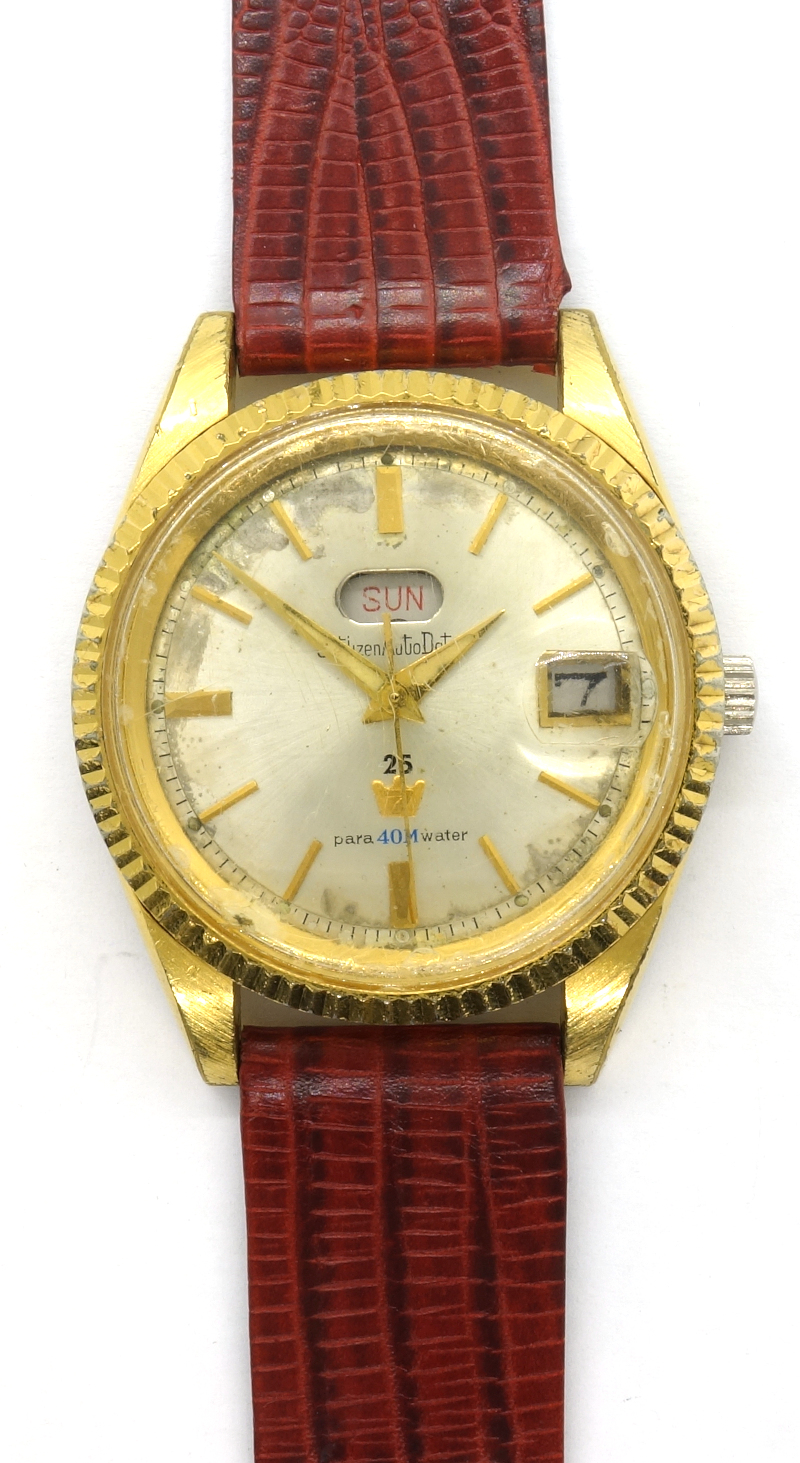
Citizen AutoDater gents watch