
ETA 2472
Description
The 11 1/2 ligne ETA 2472, which debuted in the mid-1950s, is part of one of ETA’s most successful automatic movement families and was produced for almost 20 years.
The entire caliber family is in turn based on the manual-winding ETA 2390 family.
Because of its popularity, third-party manufacturers also gave it their own caliber designation and were available, for example, as the Kienzle 70/1 or MSR T.26.
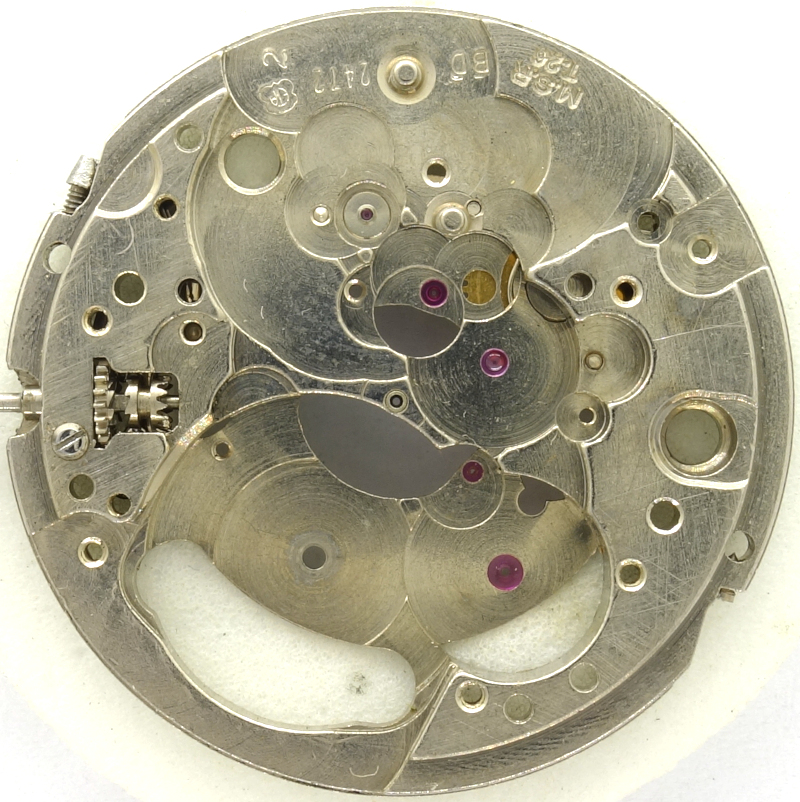
base plate
The base plate already reveals the gear train design, which was almost revolutionary at the time, and the fine workmanship of this movement. You can also see that the 11.5-ligne version extends the base plate externally, while the base caliber, the ETA 2450, has a diameter of just 10.5 lignes.
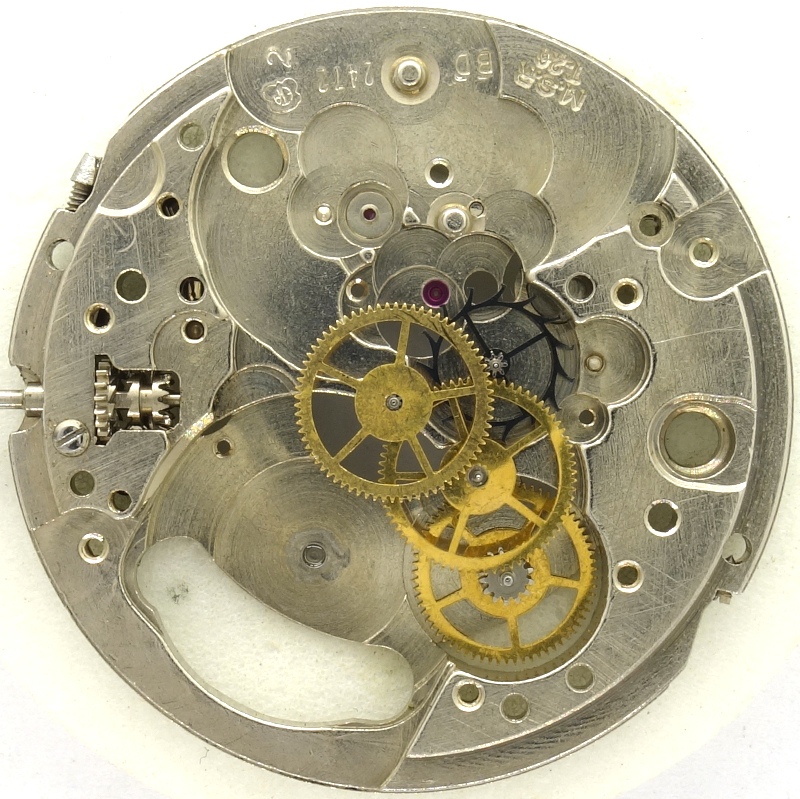
gear train
As mentioned, the gear train design is very modern and has been typical of ETA movements since the 1950s: The mainspring barrel drives the third wheel, followed by the third wheel, center seconds wheel, and escape wheel, all in a very compact and space-saving design.
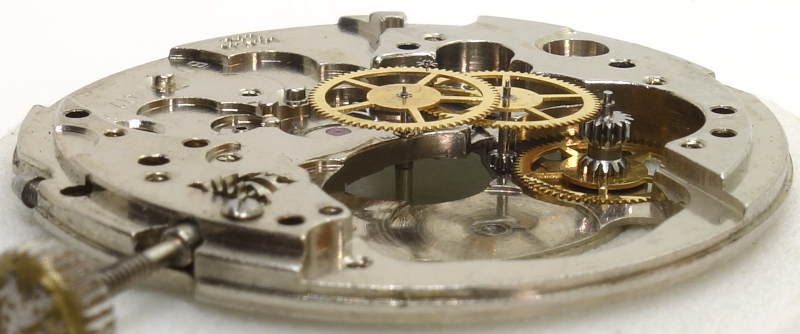
side view of the gear train
The movement is driven by the pinion of the third wheel located on the dial side, which drives the minute wheel.
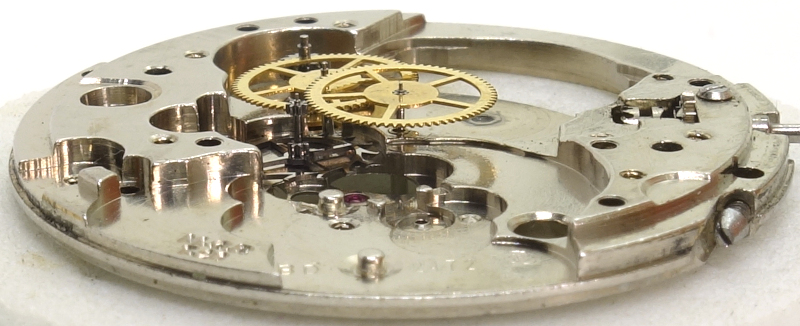
side view of the gear train
The balance, which was probably also available as a screw balance, is already a modern screwless annular balance with three spokes in these examples from the 1960s. It is protected against shocks by a pair of Incabloc shock absorbers and still operates at a slow 18,000 A/h.
The effective length of the hairspring, and thus the frequency of the balance, is adjusted using a long regulator arm.
The attached self-winding module provides recesses for both the shock absorber and the regulator arm.
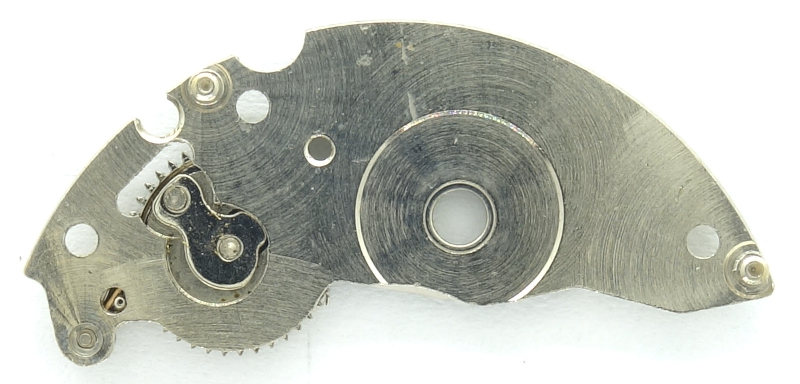
inside gear train bridge
The crown wheel is mounted on the barrel bridge for lateral movement. In the ETA 2472, the pawl engages the crown wheel, not the ratchet wheel; the latter is connected to the selfwinding module.
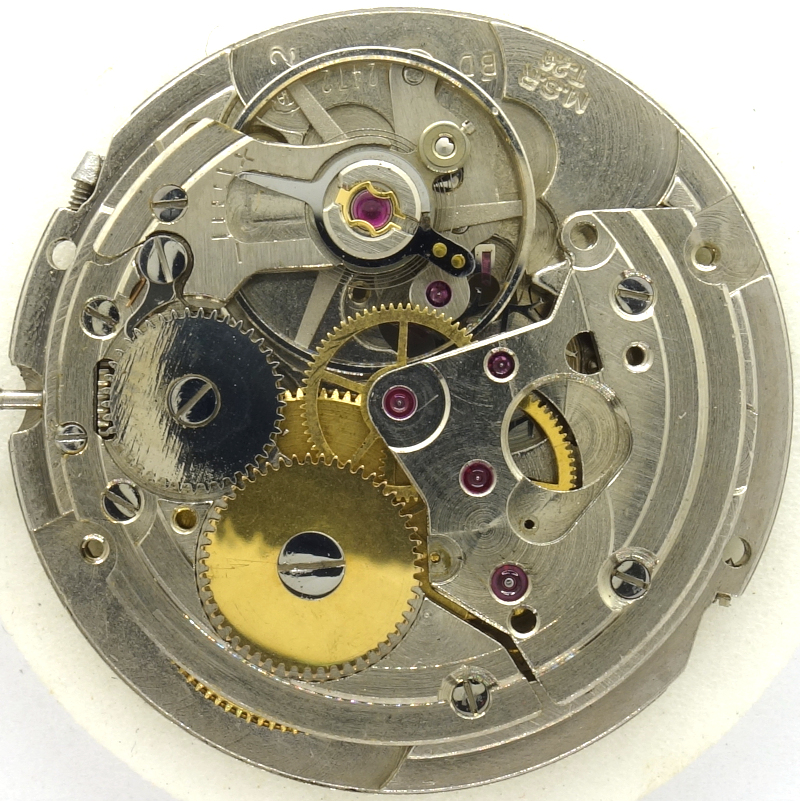
movement w/o selfwinding module
The two reduction gears of the selfwinding module (the second one engages with the ratchet wheel) are mounted on the gear train bridge; the corresponding holes for the module’s axes can be seen at 5 and 6 o’clock on half the radius.
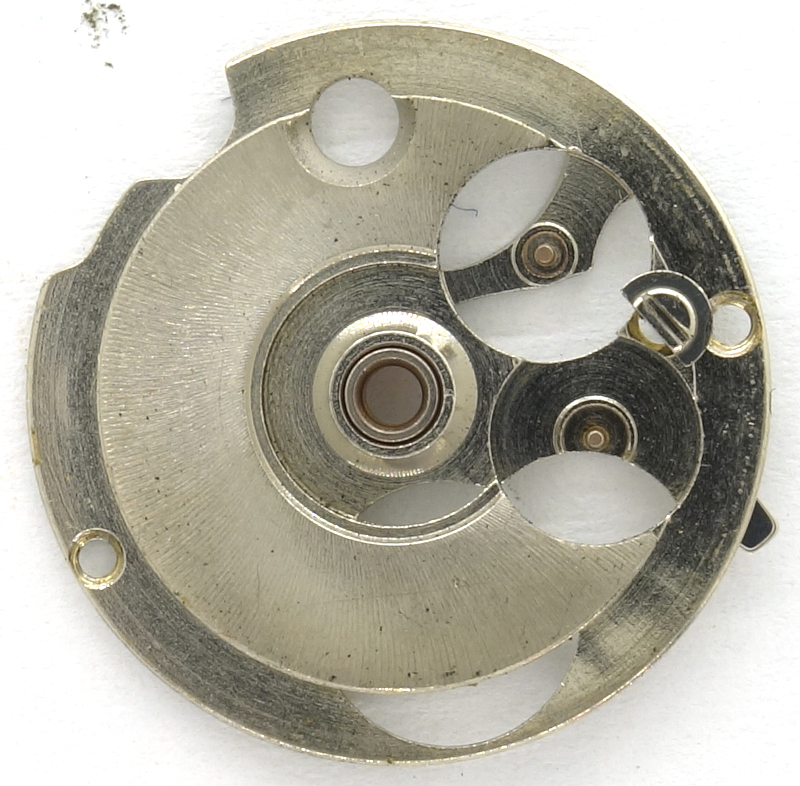
empty selfwinding module
In the old ETA selfwinding modules, the ratchet wheels are still mounted on fixed axles and do not have any axles themselves. This makes them significantly less susceptible to wear than modern ETA automatics, where the axles of the fast-rotating ratchet wheels often wear out after just a few years.
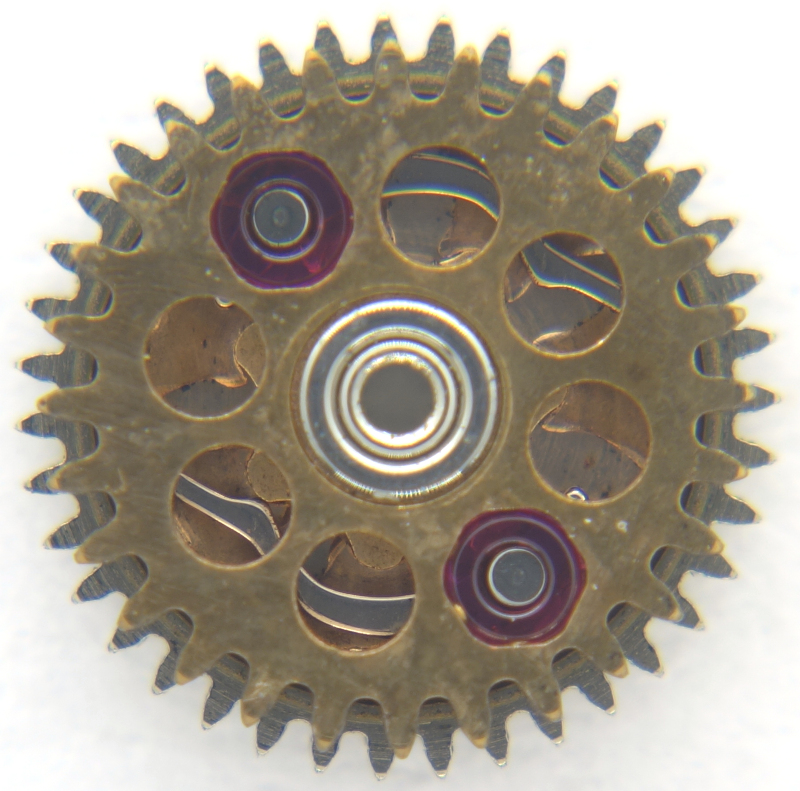
ratchet wheel
The two ratchet wheels are connected at their bottom, while the top engages with the rotor.
In one direction of rotation, the upper and lower wheels are connected, while in the other direction, they are idle.
This ensures that no matter which direction the rotor rotates, the second ratchet wheel, which drives
the reduction wheel, always rotates in the same direction.
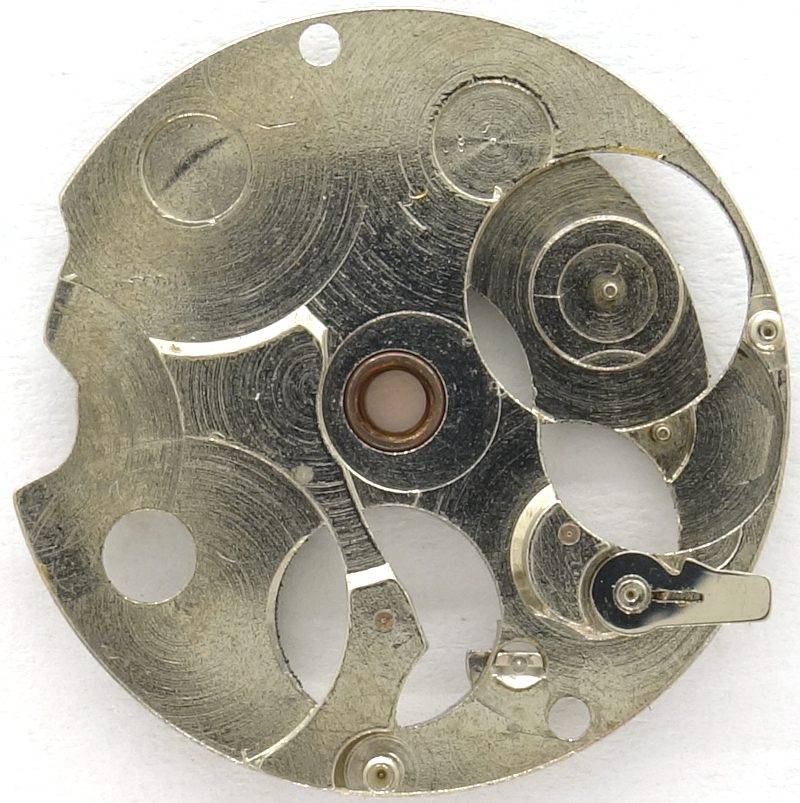
lower side selfwinding module
The two reduction gears also have hollow bearings and are mounted on the axles of the selfwinding module. A lever on the first reduction gear ensures that it does not fall out; the second reduction gear engages with the ratchet gear and therefore does not require any additional securing.
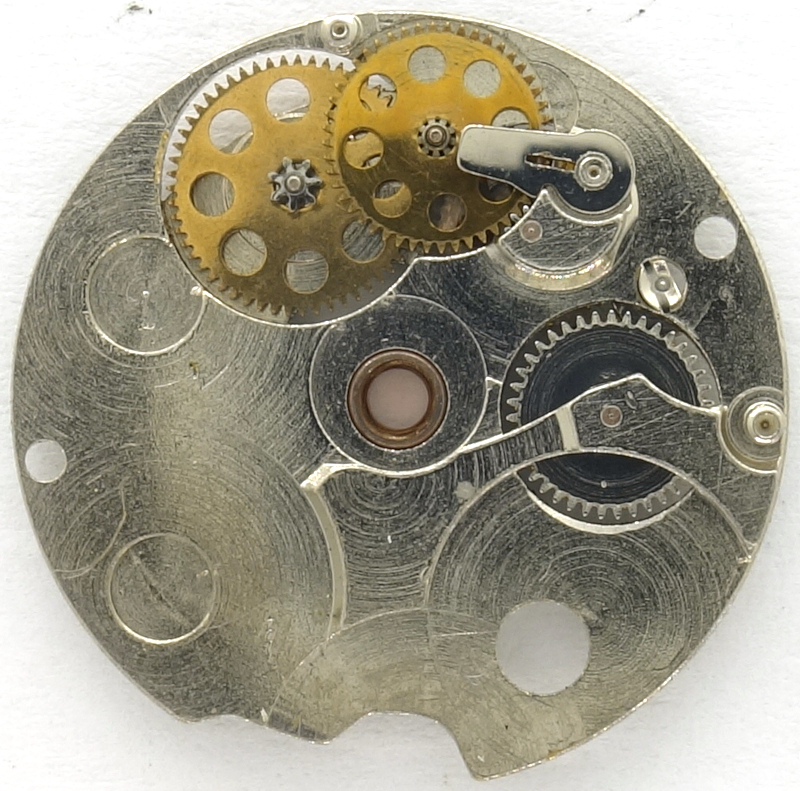
gear train of the selfwinding module
The oscillating weight of the ETA 2472 is screwed onto the inside of the module.
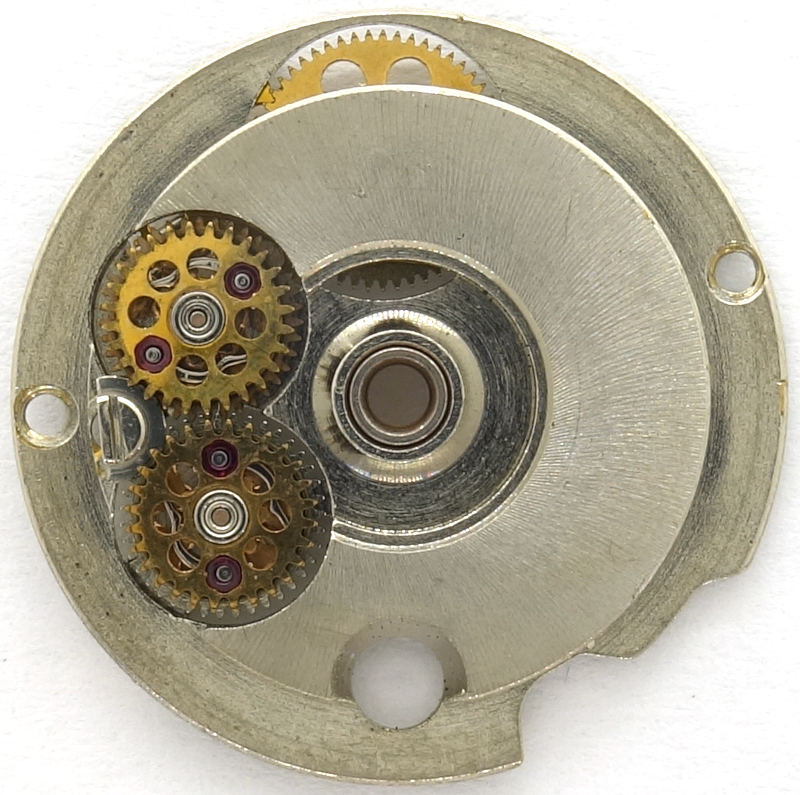
selfwinding module without oscillating weight
The rotor cannot therefore be removed without removing the selfwinding module, as is the case with later versions of ETA selfwinding movements.
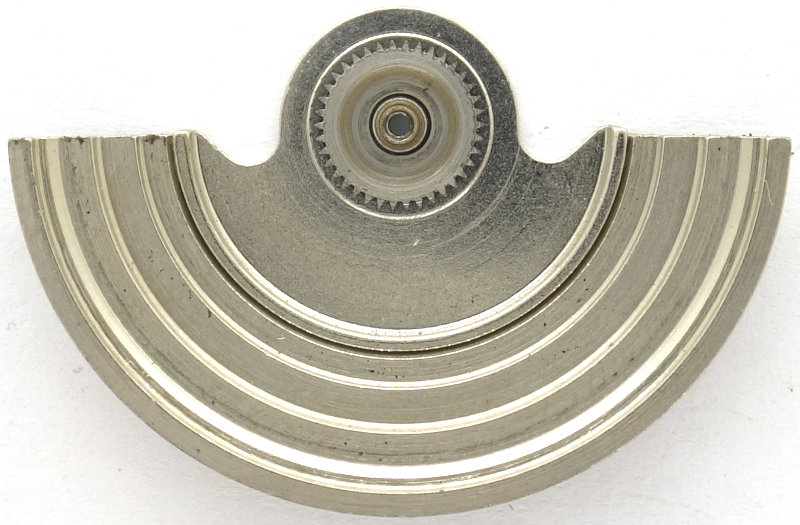
inside the rotor
The complete selfwinding module is attached to the movement with two screws.
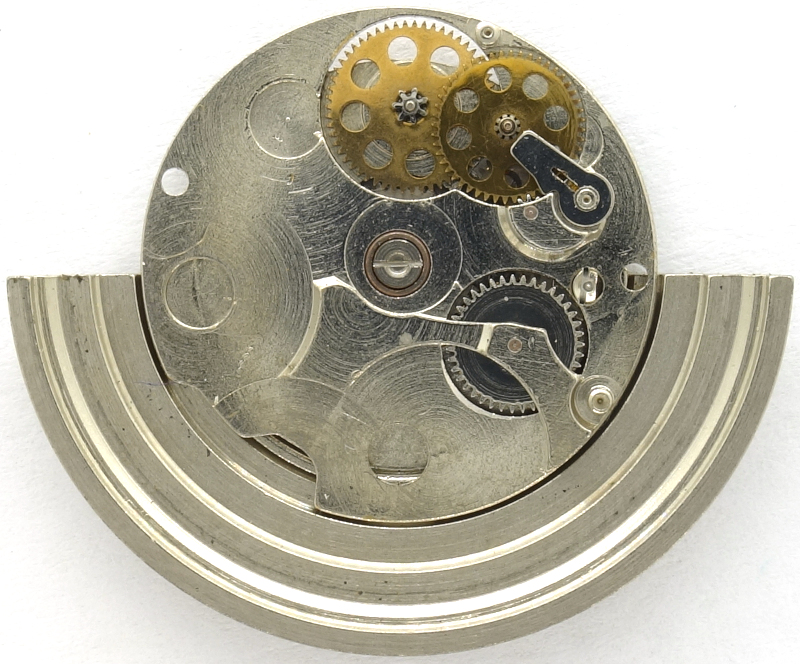
selfwinding module with rotor
As already mentioned, the movement is driven from the dial side. The pinion of the third wheel (at the 7:30 position near the center) engages with the minute wheel. On the minute wheel, equipped with a slip clutch, is the cannon pinion, which carries the minute hand, as well as the gearing for the change wheel. The change wheel is connected, as usual, to the crown wheel for setting the time.
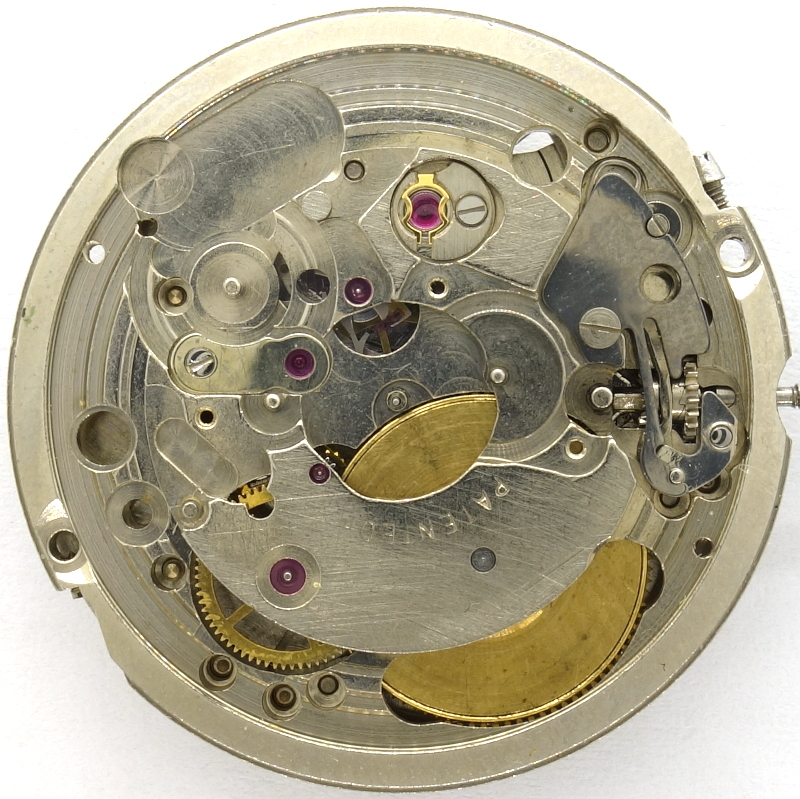
mostly empty dial side
The date mechanism of the ETA 2472 is quite complex due to its instantaneous switching at midnight, and can only be disassembled following instructions of the service manual.
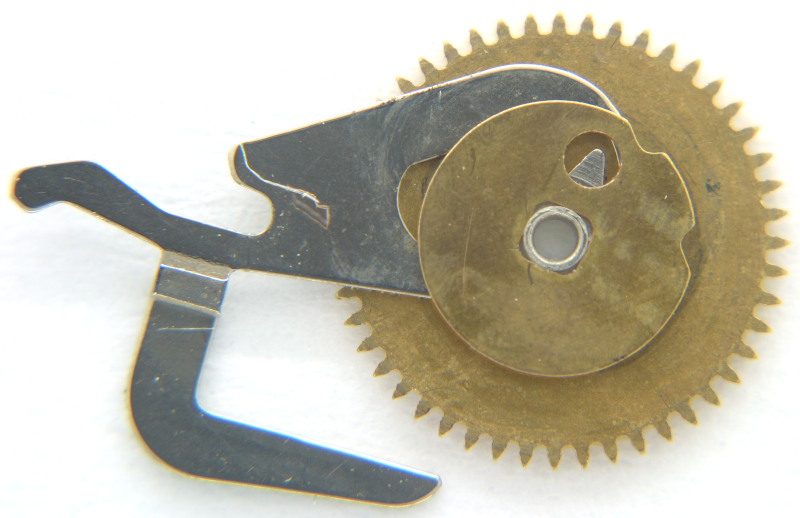
date mechanism ratchet wheel and lever
The date wheel, which rotates once a day, preloads the date lever and releases it with a single stroke at midnight.
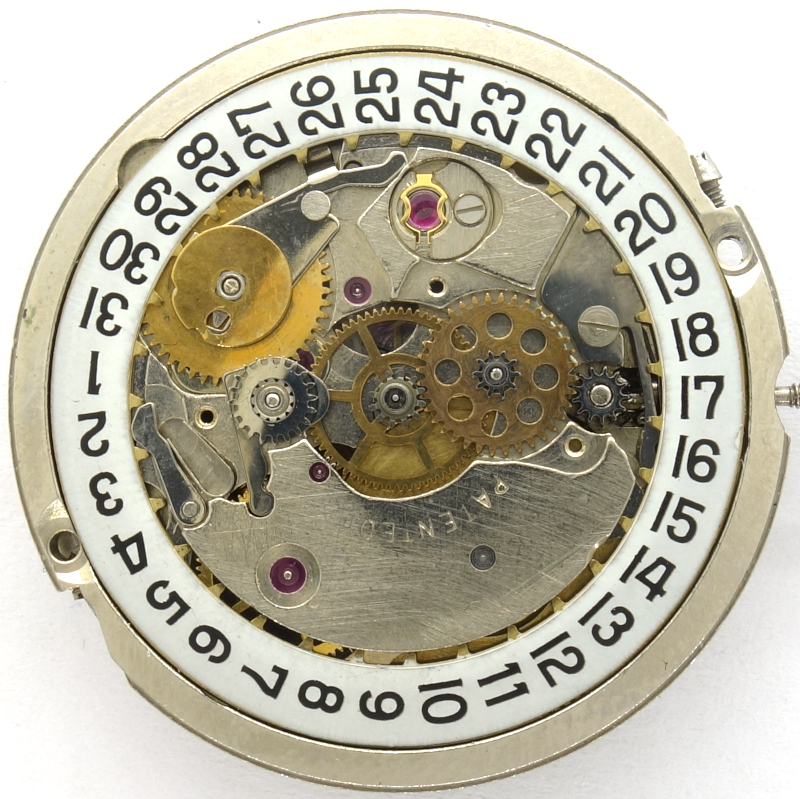
date mechanism
A semi-quick calendar correction is possible by turning the time back to 8 p.m. and then advancing it again past midnight.
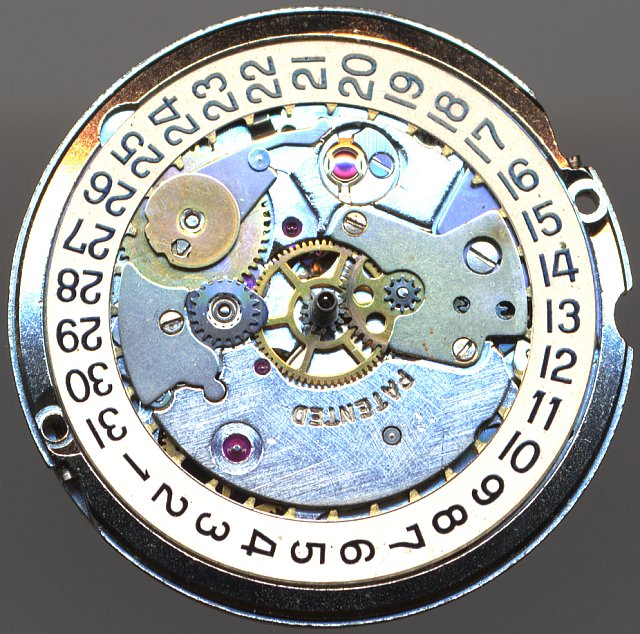
ETA 2472: Dial side
Despite its automatic movement and its complex, instantaneous switching date mechanism, the ETA 2472 is quite slim. This was certainly one of the factors contributing to the movement’s popularity.
In the lab
Timegrapher result
These rates are far below what this movement is normally capable of. With a professional overhaul, it could at least bring it close to the chronometer standard.| horizontal positions | |||
|---|---|---|---|
| dial up | +9 s/d | 231° | 0,1ms |
| dial down | +-0 s/d | 238° | 0,2ms |
| vertical positions | |||
| crown right (12 up) | -9 s/d | 214° | 0,3ms |
| crown up (3 up) | -17 s/d | 208° | 0,0ms |
| crown left (6 up) | -52 s/d | 191° | 0,0ms |
| crown down (9 up) | -57 s/d | 183° | 0,3ms |
Technical data
| Manufacturer: | ETA |
| Caliber: | 2472 |
| Caliber base: | ETA 2450 |
| Size: | 11 1/2''' (measured: 25,6mm) |
| Height: | 5,2mm |
| A/h: | 18000 |
| lift angle: | 52° |
| Number of jewels: | 21 |
| Escapement: | Pallet lever |
| Balance types: | Nickel anular balance |
| Shock protection(s): | Incabloc |
| Balance bearing / direction hairspring: | Clockwise |
| Moveable stud: | yes |
| Adjust mechanism: | Long regulator arm |
| Construction: |
|
| Winding mechanism: | yoke winding system |
| Setting lever spring: | 2 holes |
| Attachment of setting lever: | screwed |
| Features: |
|
| Production period: | 1956 - 1974 |
| References: | Flume: 1962 100 |
| Mentioning in literature (years): | 1963 - 1971 |
| Data sheet: | 1965 |
| Inventory number: | 24026 |
Usage gallery
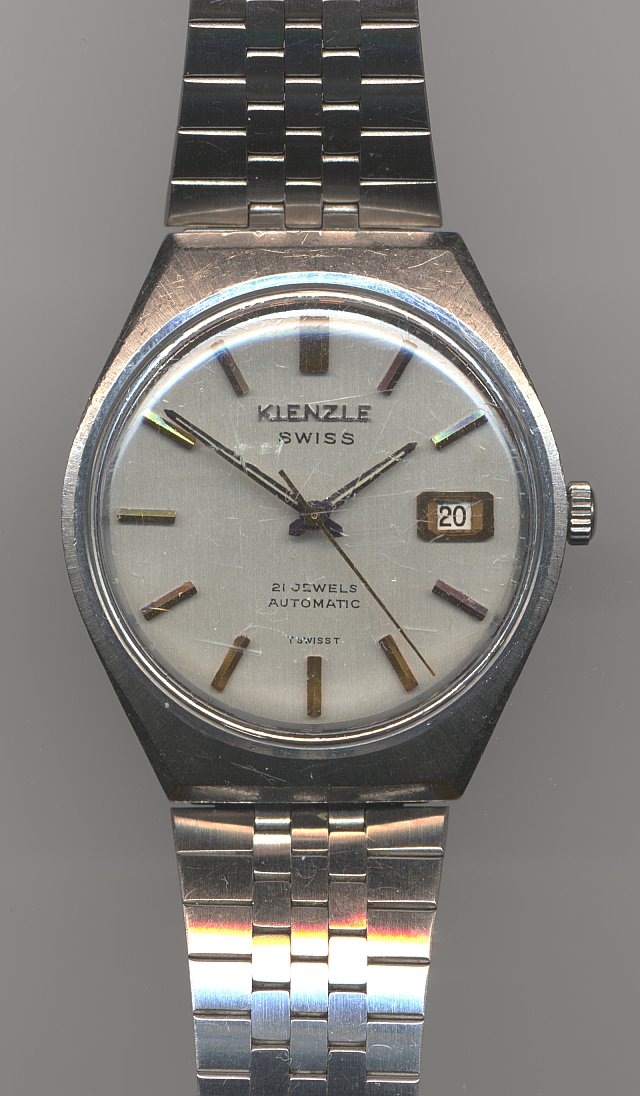
Kienzle Swiss Automatic gents watch

Revue Touring Automatic gents watch
Related Movements
Links
- Service of a shipwrecked ETA 2472 (Beautiful detailed shots of an ETA 2472 being serviced)