
Förster 2080
Description
The successor to the Förster 2075, the caliber Förster 2080, with the same size of 8 3/4 x 12 lignes as its predecessor, is likely to have been launched in the late 1940s.

base plate
The base plate reveals the major changes that have been made:
The ratchet and spring of the rocking bar winding mechanism have moved to the dial side,
and a fourth pillar, bottom right, indicates that changes have been made to the
gear train bridge, too.
The quality of the movement has remained the same, and all important bearings are again fitted with jewels.

gear train
The gear train itself has remained the same; like its predecessor, it consists of a barrel, central minute wheel, third wheel, decentral seconds wheel at 6 o’clock, and the steel escape wheel.
The biggest difference is that the gear train bridge is now supported by three pillars and features a semicircular cutout around the balance wheel.
Since the additional pillar is located exactly where the pallet cock used to be, it had to be redesigned and repositioned.

side view of the gear train
There were no changes to the balance section; it also uses a monometallic, non-shock-resistant screw balance that beats with 18,000 A/h, and whose effective length of the hairspring is adjusted using a fairly long regulator.

Detail: Lever
There are also versions of this movement where the lever is equipped with transparent, rather than ruby-red, pallets. However, this should have no technical impact.
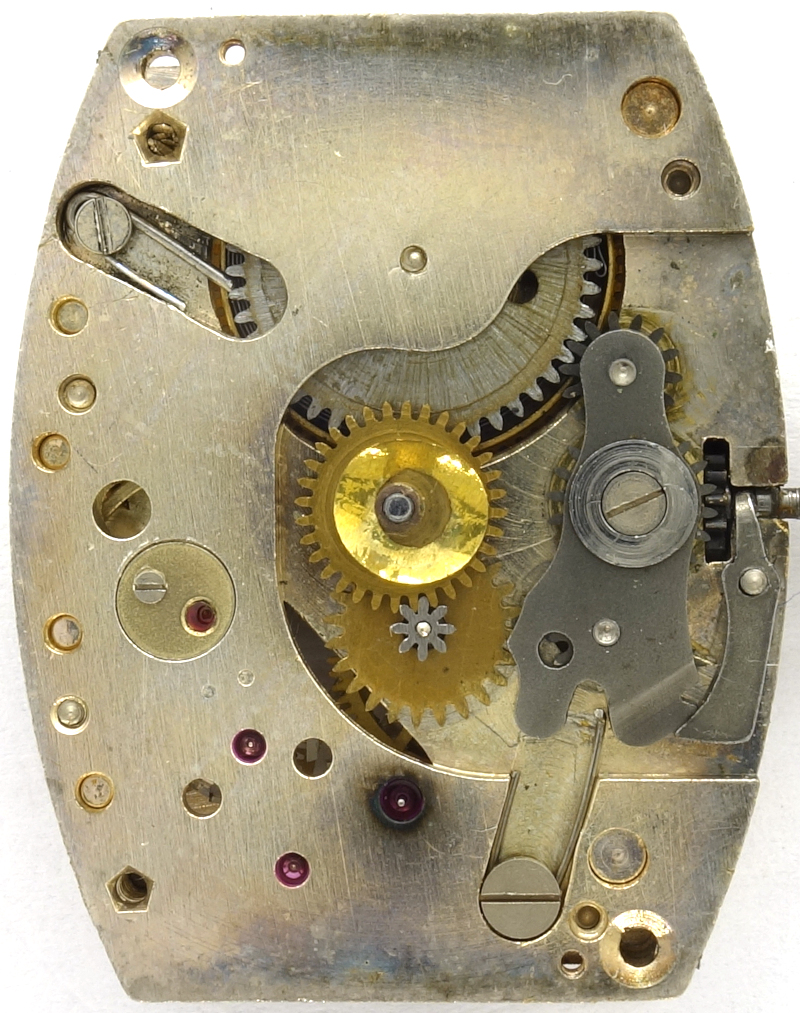
Förster 2080: Dial side
On the dial side, you can see the rocking bar winding mechanism, whose spring has now been moved to the dial side for easy service.
The ratchet mechanism has been significantly simplified and is now located at position 10 o’clock on the dial side. Instead of a click and spring, only a simple, sturdy U-shaped spring is used that engages with the teeth of the ratchet wheel. Winding is not a pleasant experience, and such springs are prone to breaking or bending so that they no longer provide reliable engagement. However, it can now be replaced easily and without disassembling the movement.
In the lab
Timegrapher result
Despite a simple service, the timegrapher rates are still not as good as hoped; professional service could certainly improve this.| horizontal positions | |||
|---|---|---|---|
| dial up | +25 s/d | 328° | 2.5ms |
| dial down | +5 s/d | 332° | 2.7ms |
| vertical positions | |||
| crown right (12 up) | +35 s/d | 235° | 4.1ms |
| crown up (3 up) | +60 s/d | 232° | 4.4ms |
| crown left (6 up) | +35 s/d | 250° | 3.1ms |
| crown down (9 up) | -120 s/d | 200° | 3.9ms |
Technical data
| Manufacturer: | Förster |
| Caliber: | 2080 |
| Size: | 8 3/4 x 12''' (measured: 20,0 x 24,0mm) |
| A/h: | 18000 |
| Number of jewels: | 15 |
| Escapement: | Pallet lever |
| Balance types: | Nickel screw balance |
| Shock protection(s): | none |
| Balance bearing / direction hairspring: | Clockwise |
| Moveable stud: | no |
| Adjust mechanism: | Long regulator arm |
| Construction: |
|
| Construction type: | pillar construction |
| Winding mechanism: | rocking bar winding system |
| Setting lever spring: | 4 holes |
| Attachment of setting lever: | screwed |
| Features: |
|
| References: | Feilner: Bl. 44 4006 Flume: 1952 36 |
| Mentioning in literature (years): | 1950 - 1951 |
| Datasheet: | Furniture catalog late 1940s |
| Inventory number: | 24025 |
Usage gallery

AXA gents watch

Förster gents watch