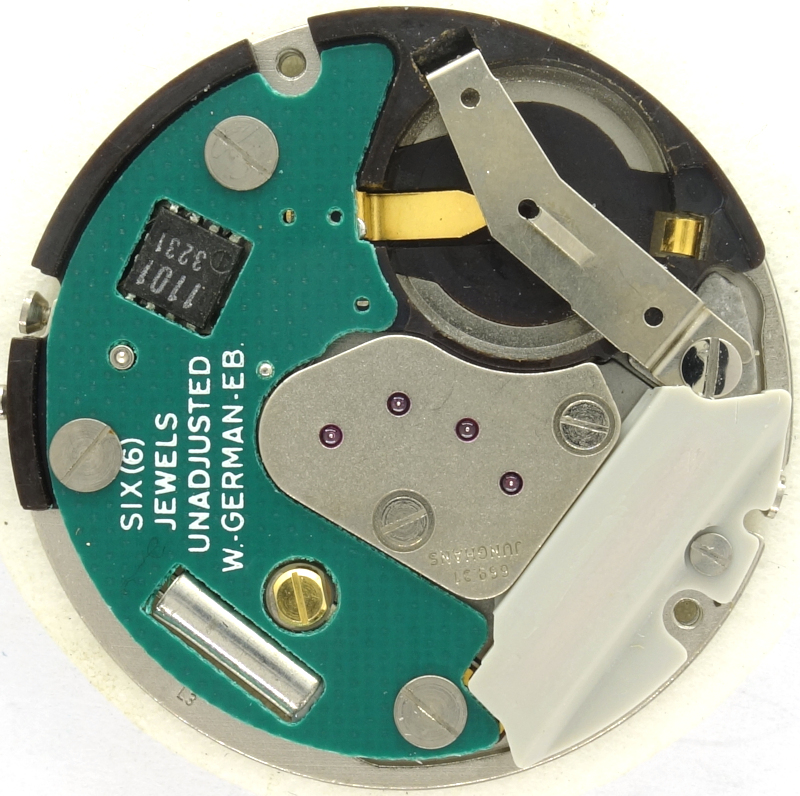
Junghans 669.31
Description
One of the latest pure-bred quartz movements “Made in Germany” from Junghans was the particularly flat 669 caliber series, which includes the caliber presented here, Junghans 669.31, with a diameter of 11.5 lignes and a date indicator with quick-set function.
Interestingly, this caliber is not listed in the official Junghans caliber overview. Perhaps it was a modification for a special model? The watch in which it is installed does not bear the Junghans name either, but does bear an official Junghans catalog number and a “Made by Junghans Germany” at the bottom of the dial.
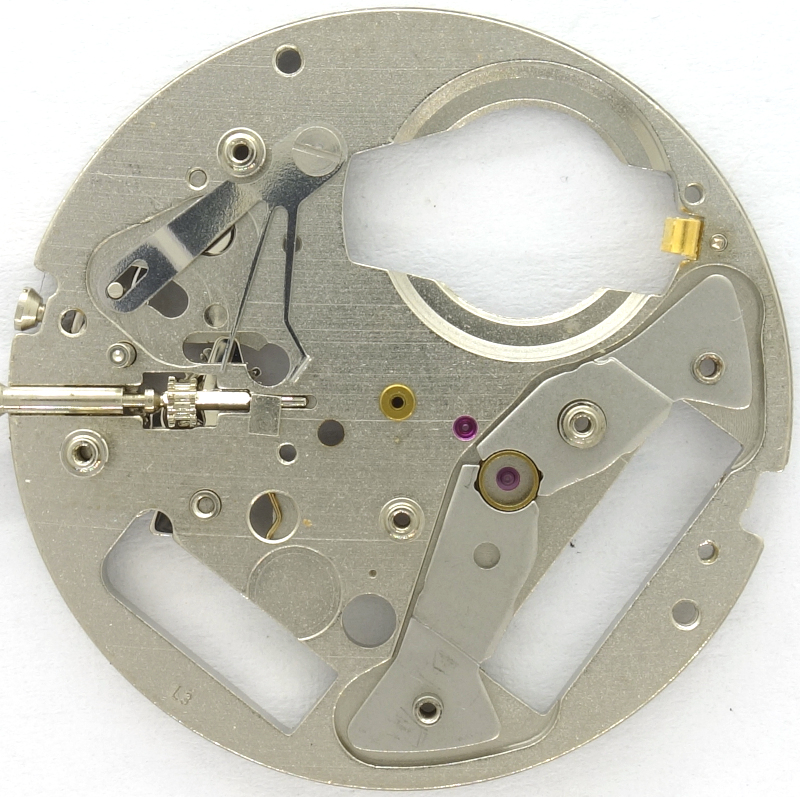
base plate
Compared to today’s quartz movements, it was quite large, the space on the base plate was well utilized, and it even featured jewel bearings: two on the base plate and four on the gear train bridge.
A mechanical stop-second mechanism was even implemented on the movement side.
The production code “L3” dates the movement to November 1983, at the very end of its production period.
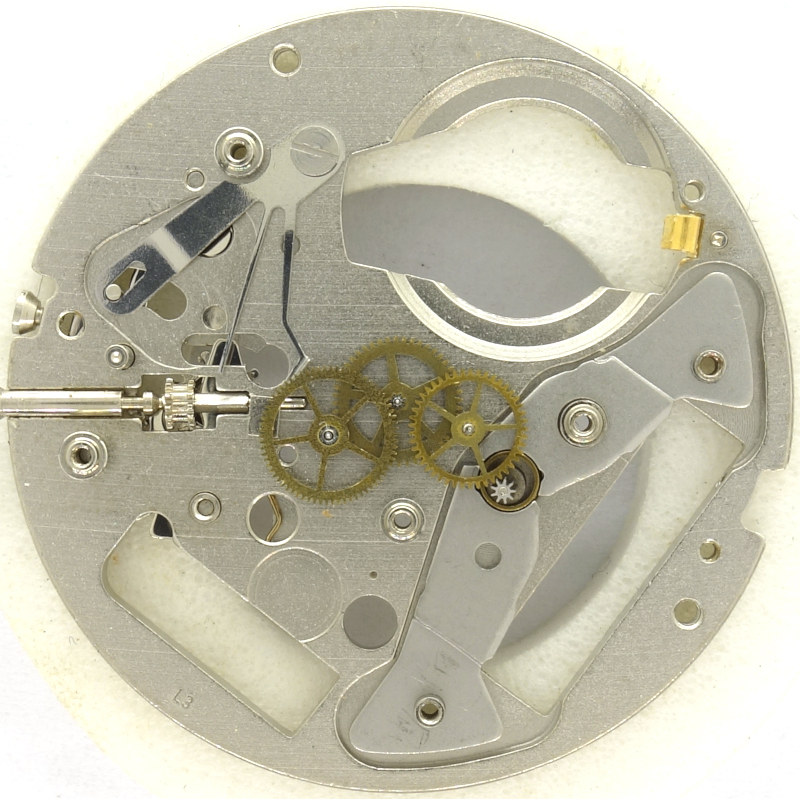
gear train
The gear train is quite typical for quartz movements: The rotor with its permanent magnets drives a reduction gear, followed by the central second wheel and third wheel.
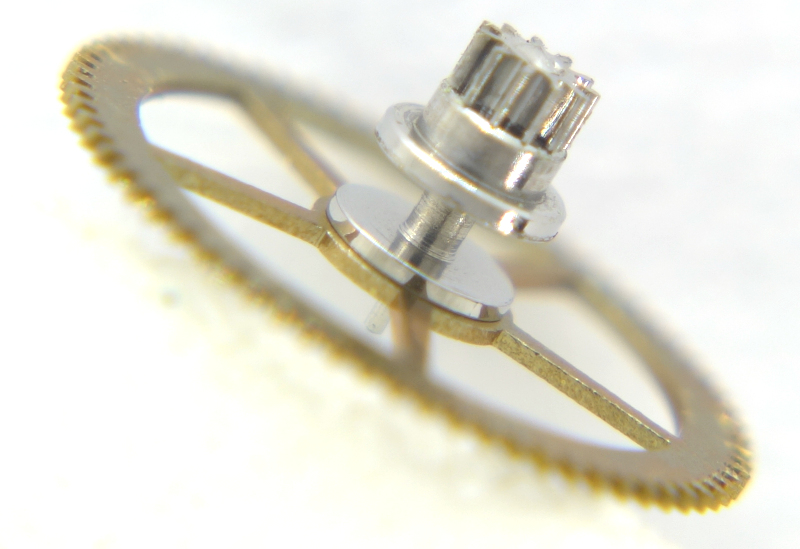
third wheel
The movement is driven on the dial side by the pinion of the third wheel, which, incidentally, is only pivot-mounted at the factory. On the dial side, the wide ring above the pinion serves as the bearing. For a wheel that rotates slowly and with little power, this is sufficient.
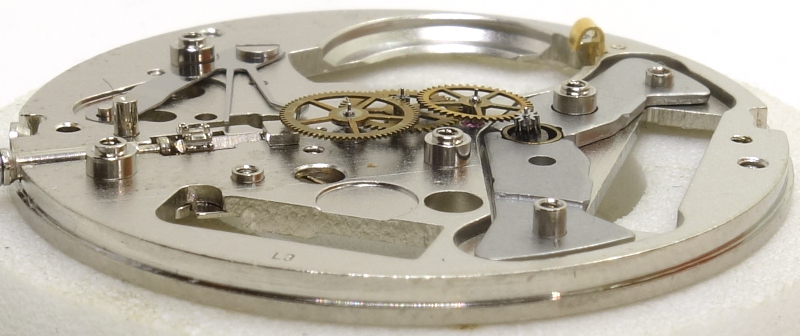
side view of the gear train
The gear train bridge sits on two pivots; a solid mechanism is unnecessary due to the low power involved.
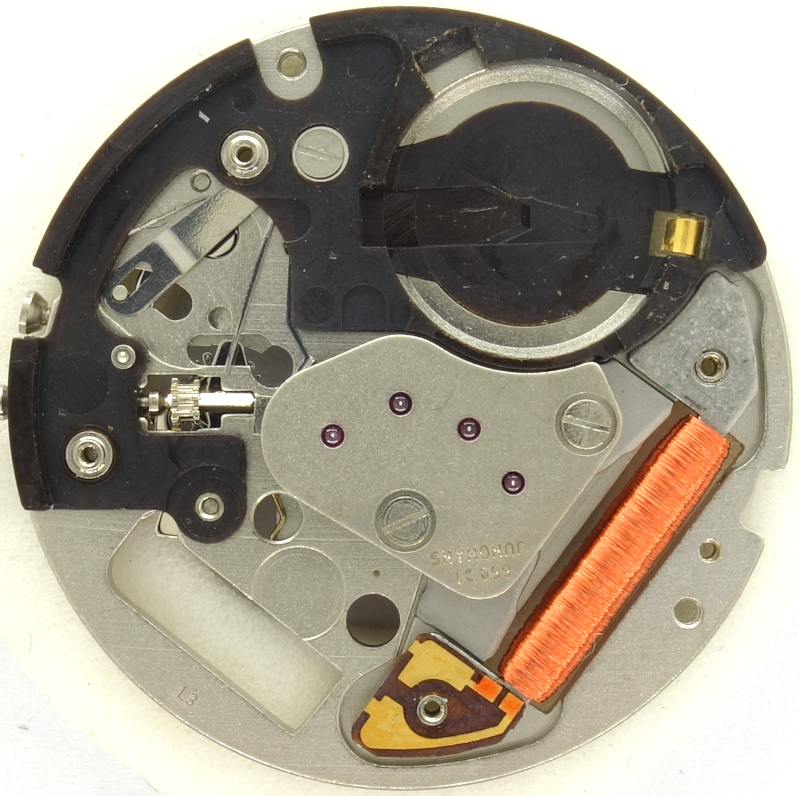
w/o electronics module
Part of the factory is housed in plastic, among other things to insulate the battery.

bottom of the electronic module
The electronic module has no special design features; the nice thing is that it can still be adjusted using a trimming capacitor.
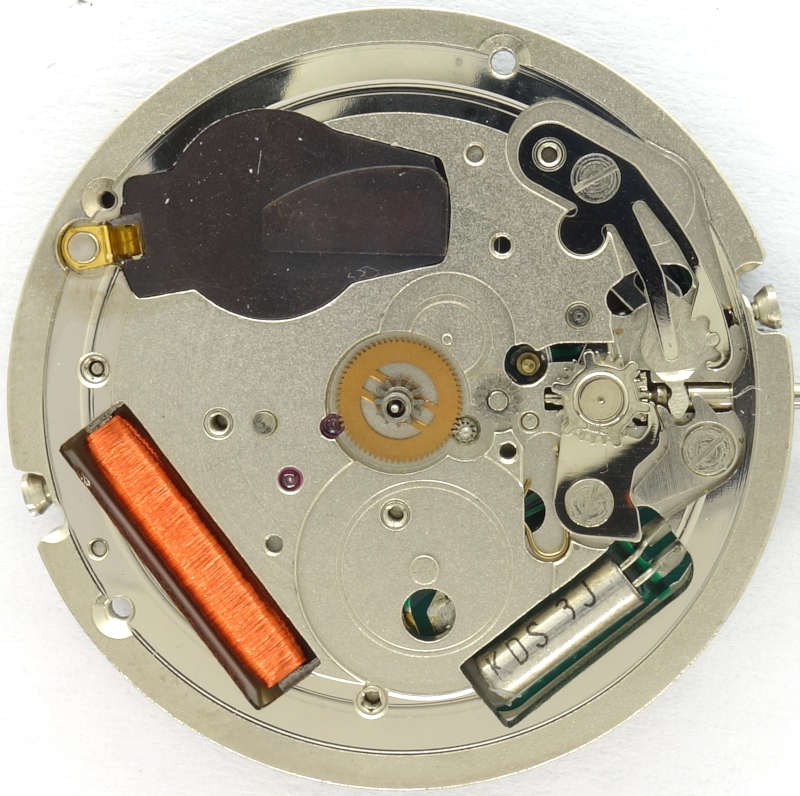
yet mostly empty dial side
On the dial side, you can clearly see how the minute wheel is driven by the third wheel’s inion described above. Attached to this minute wheel, with a slip clutch, is the cannon pinion, which, on the one hand, carries the minute hand and, on the other hand, drives the change wheel (not yet visible here), which in turn drives the hour wheel and is also connected to the transmission wheel of the crown mechanism for time correction.
You can also see the crown’s clutch mechanism and the quick-set mechanism of the date ring (at 3 o’clock), which is used in the center crown notch – quite typical for this type of quartz watch.
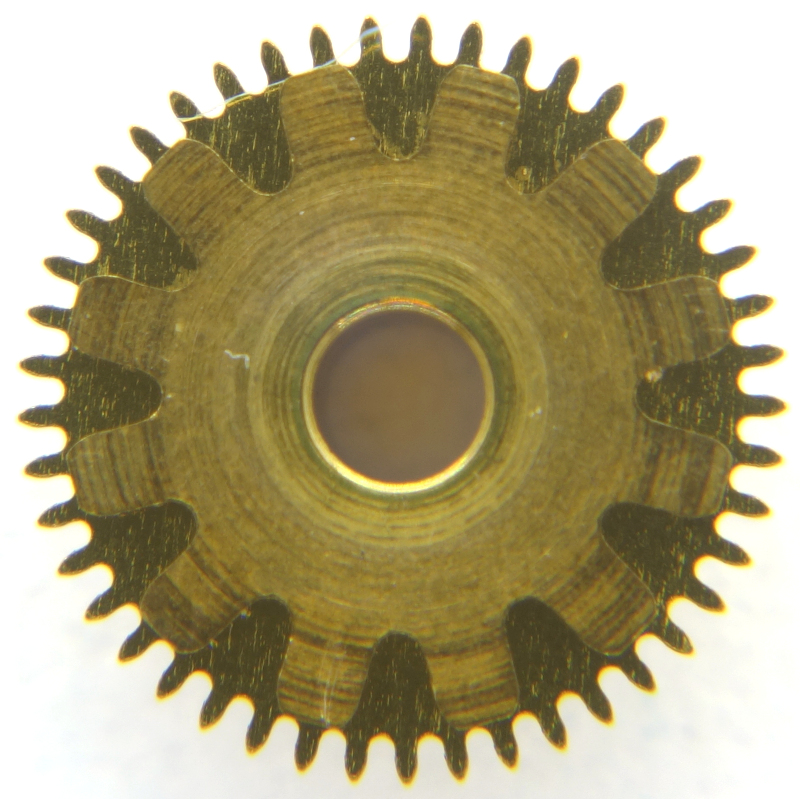
bottom of the hour wheel
The date wheel, located at the 6 o’clock position, is driven by the hour wheel, which has a coarse, 12-tooth gear on its underside that connects to the large plastic date wheel.
The movable index finger prevents damage to the date mechanism when the date is corrected via the crown mechanism during the setting process (roughly from 8 p.m. to 4 o’clock).
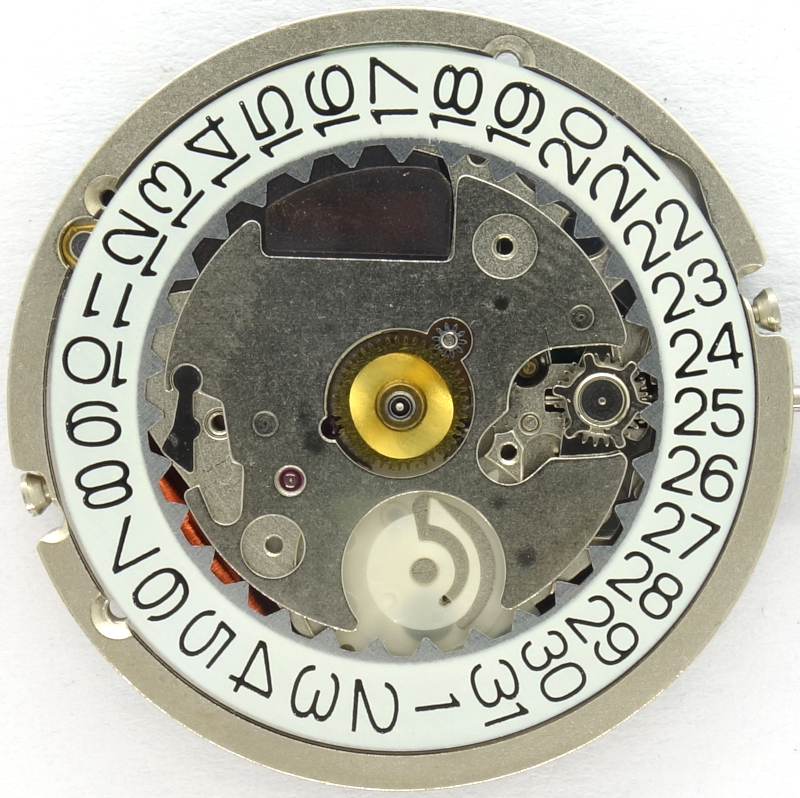
open calendar mechanism
Despite the date function, the entire movement is only 2.75mm thick; it would be hard to make it much thinner, and if it were, it would be at the expense of battery size.
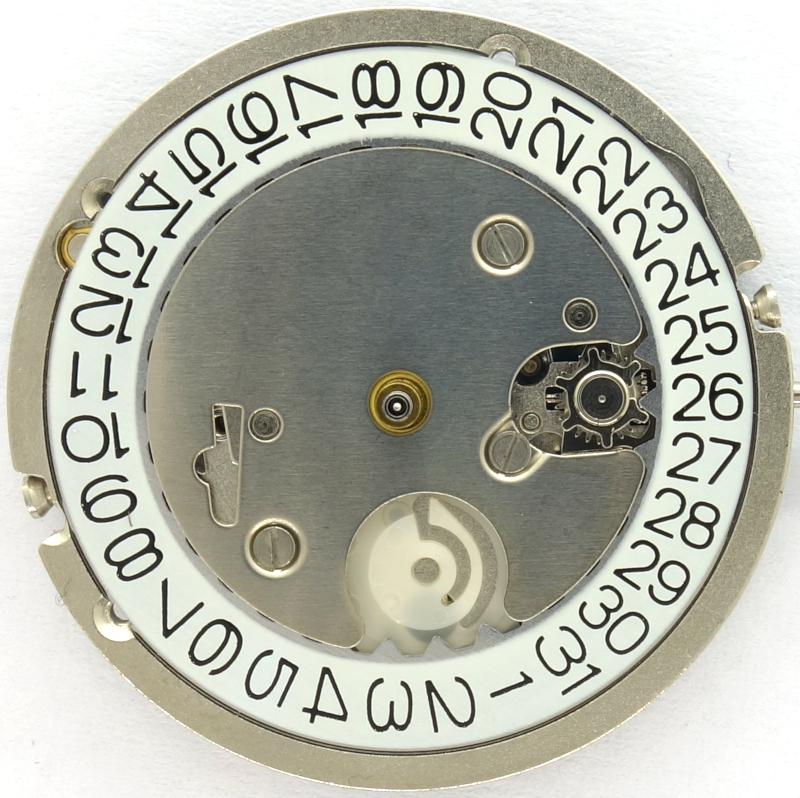
Junghans 669.31: Dial side
Technical data
| Manufacturer: | Junghans |
| Caliber: | 669.31 |
| Size: | 11 1/2''' (measured: 25,8mm) |
| Height: | 2,75mm |
| Frequency: | 32768 Hz |
| Number of jewels: | 6 |
| Escapement: | Quartz |
| Adjust mechanism: | Variable capacitor |
| Construction: |
|
| Winding mechanism: | yoke winding system |
| Setting lever spring: | 2 holes |
| Features: |
|
| Production years: | 1978?-1983? |
| Inventory number: | 24029 |
Usage gallery
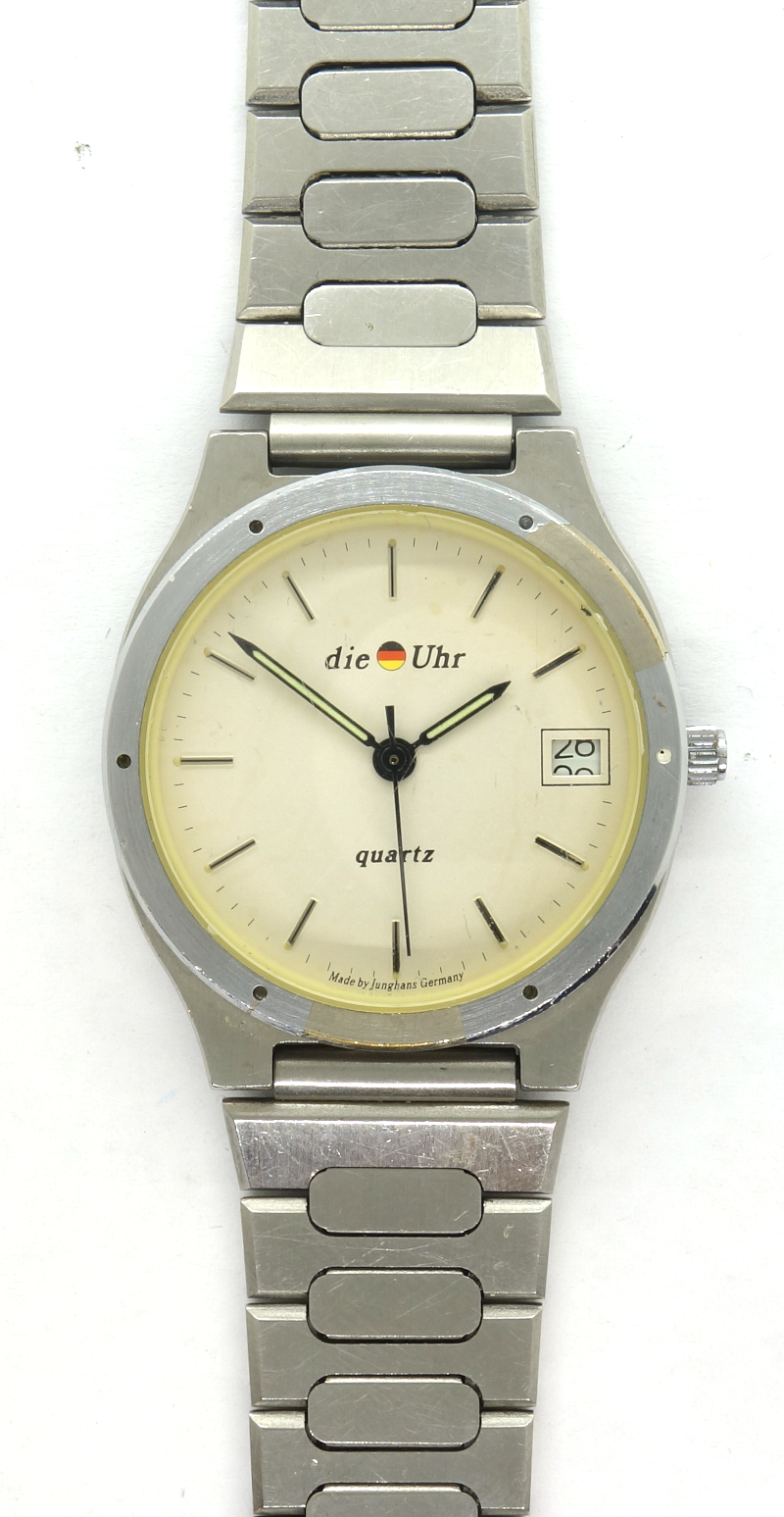
"Die Uhr" gents watch (Junghans modell 41/4320)