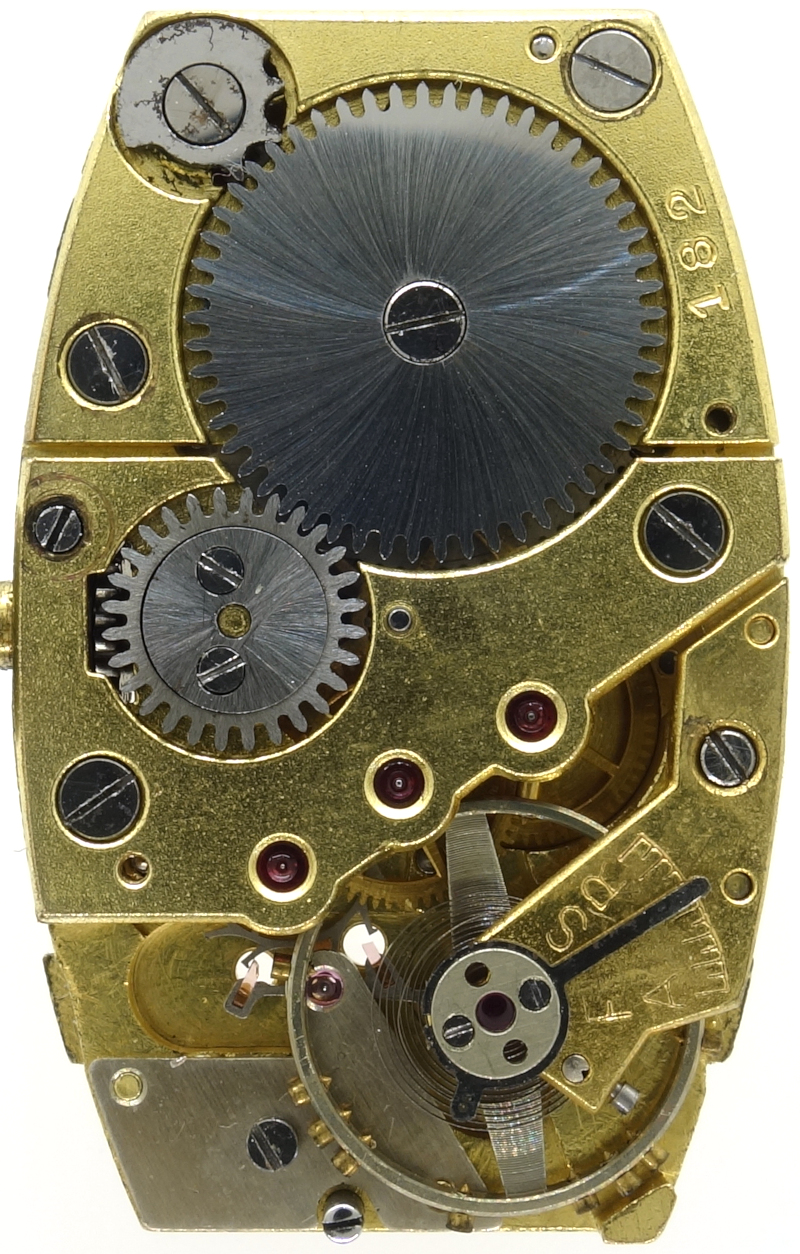
Lip T18
Description
The Lip T18 is the movement of the legendary “Churchill” watch, which was presented to Sir Winston Churchill by the French government in 1948 for his services in the Second World War.

container
The 7 3/4 x 11 ligne tonneau-shaped windup movement from France, protected against dirt and amateur repair attempts in a screwed-down container, was one of Lip’s most popular calibers and, as the basis for the Russian Zaria 2602 “Zvezda”, marked the beginning of Russian wristwatch production.
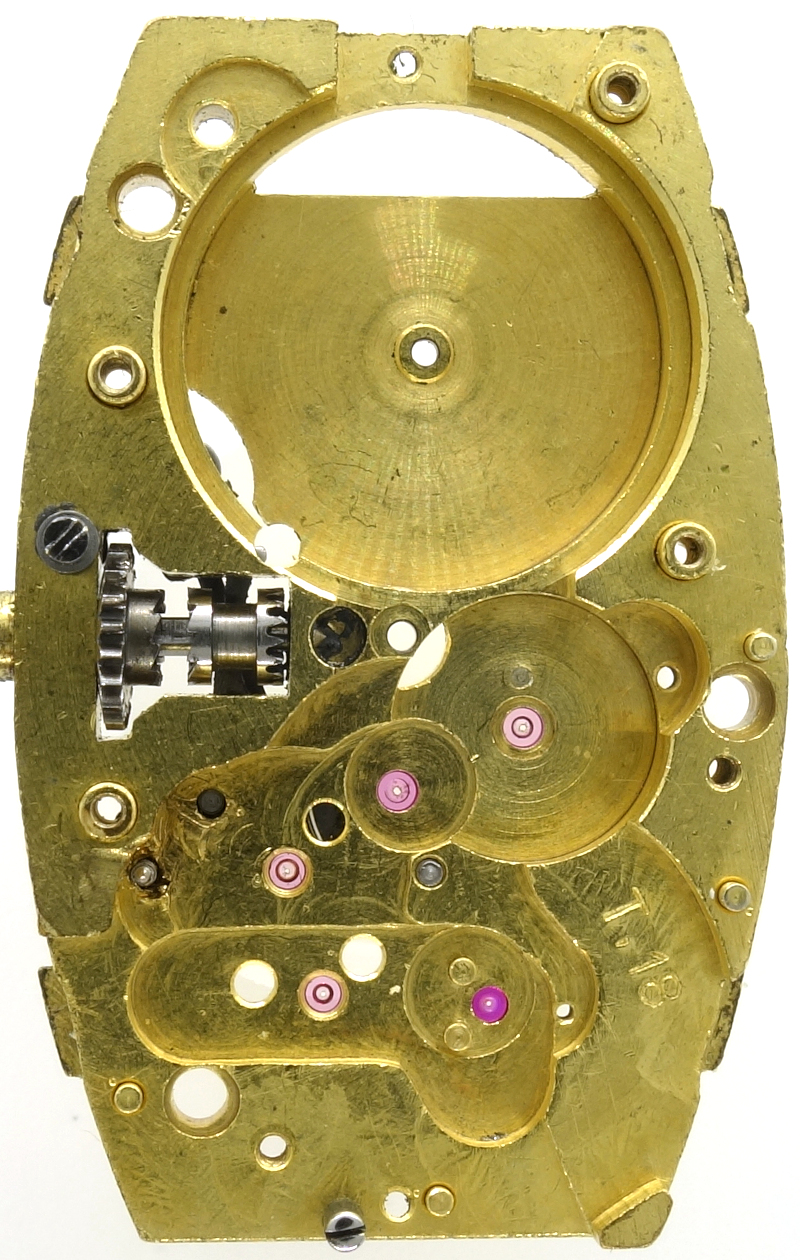
base plate
The tonneau-shaped design allows a particularly large mainspring barrel and a large screw balance. Both have a positive effect on the power reserve and accuracy.
Naturally, all the important bearings in this movement are jeweled, which are not only technically important but also harmonize beautifully with the movement’s gold tone.
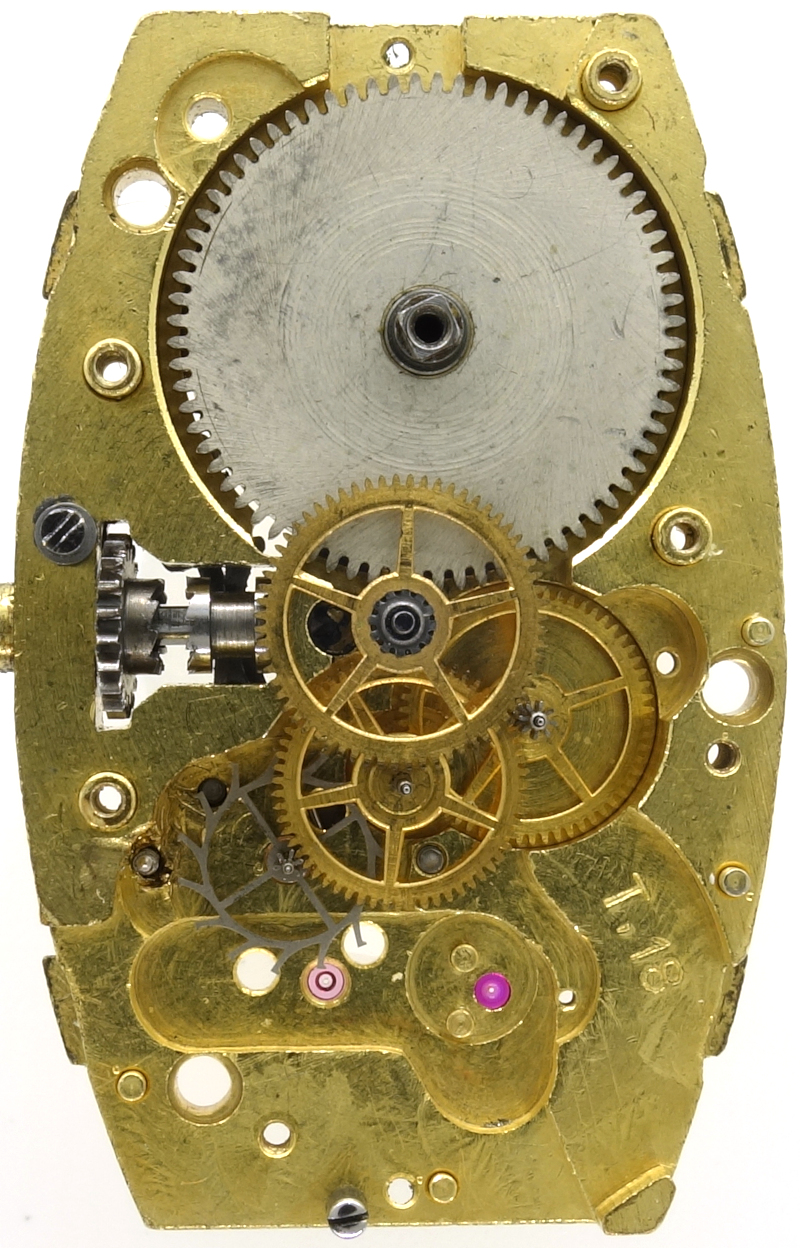
gear train
The gear train is of course classically constructed; the mainspring barrel directly drives the central minute wheel, followed by the third wheel, the decentral seconds wheel at 6 o’clock, and the escape wheel. The latter three are aligned in a row.
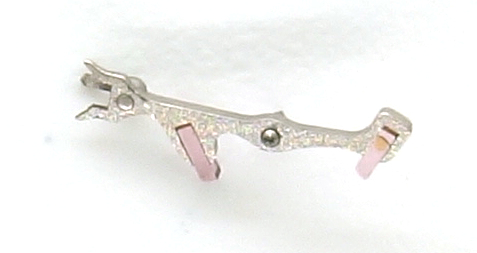
lateral lever
The lateral lever used is technically interesting, as its fork is mounted longitudinally on one side and not vertically symmetrically. The lever pallets he uses are traditional.
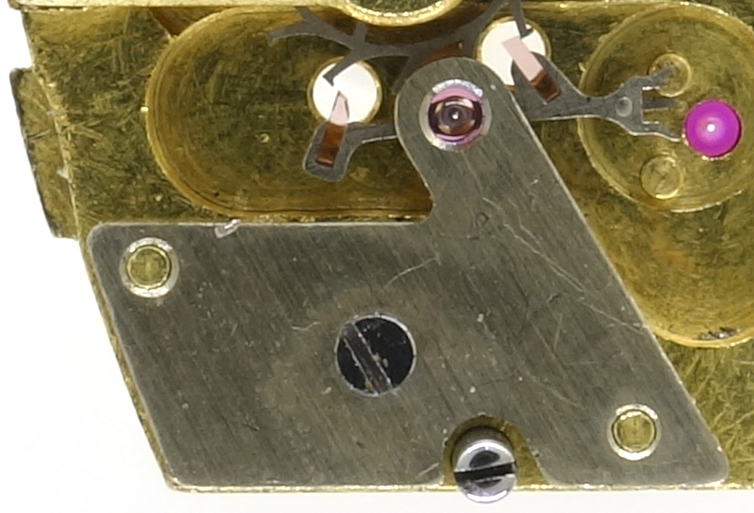
eccentric screw of the lever cock
The purpose of the eccentric screw on the lever cock is unclear, as it cannot be adjusted due to the two other bearing pins into which it engages. It may simply be a manufacturing defect in the screw production.
(Don’t be surprised that the left pallet of the lever is defective and therefore unusually pointed. This is, of course, not typical for this movement.)
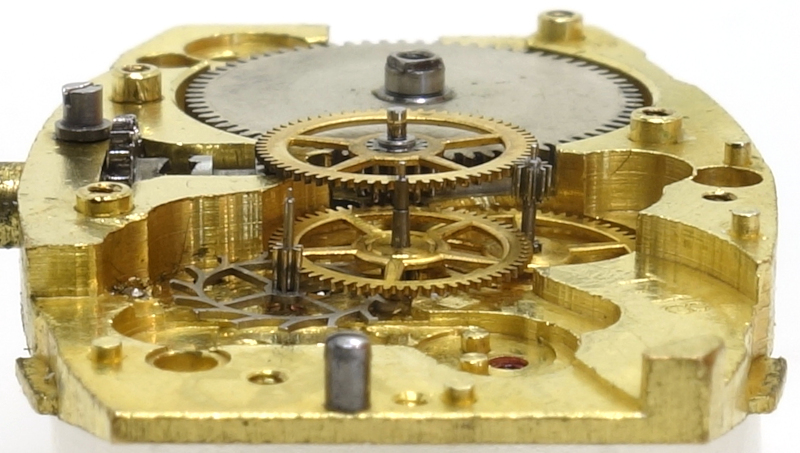
side view of the gear train
A large, monometallic screw balance was used, which is not yet shock-protected.
Its balance spring has a Breguet terminal curve, which, in combination with a long regulator arm, allows the precise adjustment of the beat rate of 18,000 A/h.
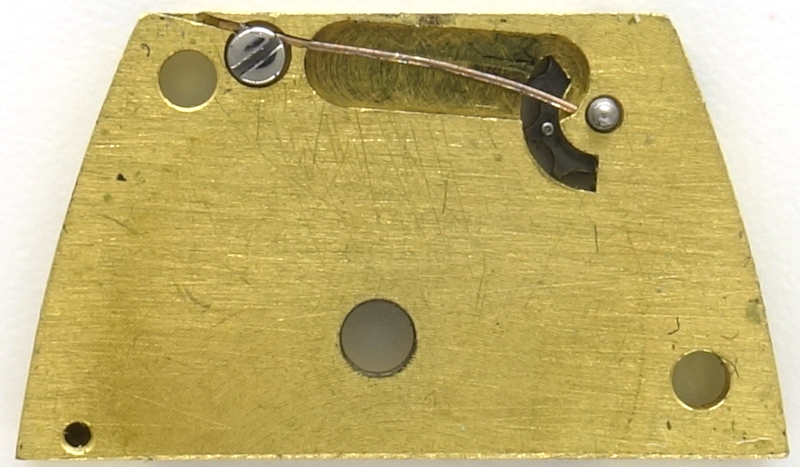
inside the barrel bridge
A small but very practical solution for the watchmaker can be found on the inside of the mainspring barrel bridge: The locking spring, which acts on the ratchet mechanism, here from the inside, is secured against flying out with a screw.
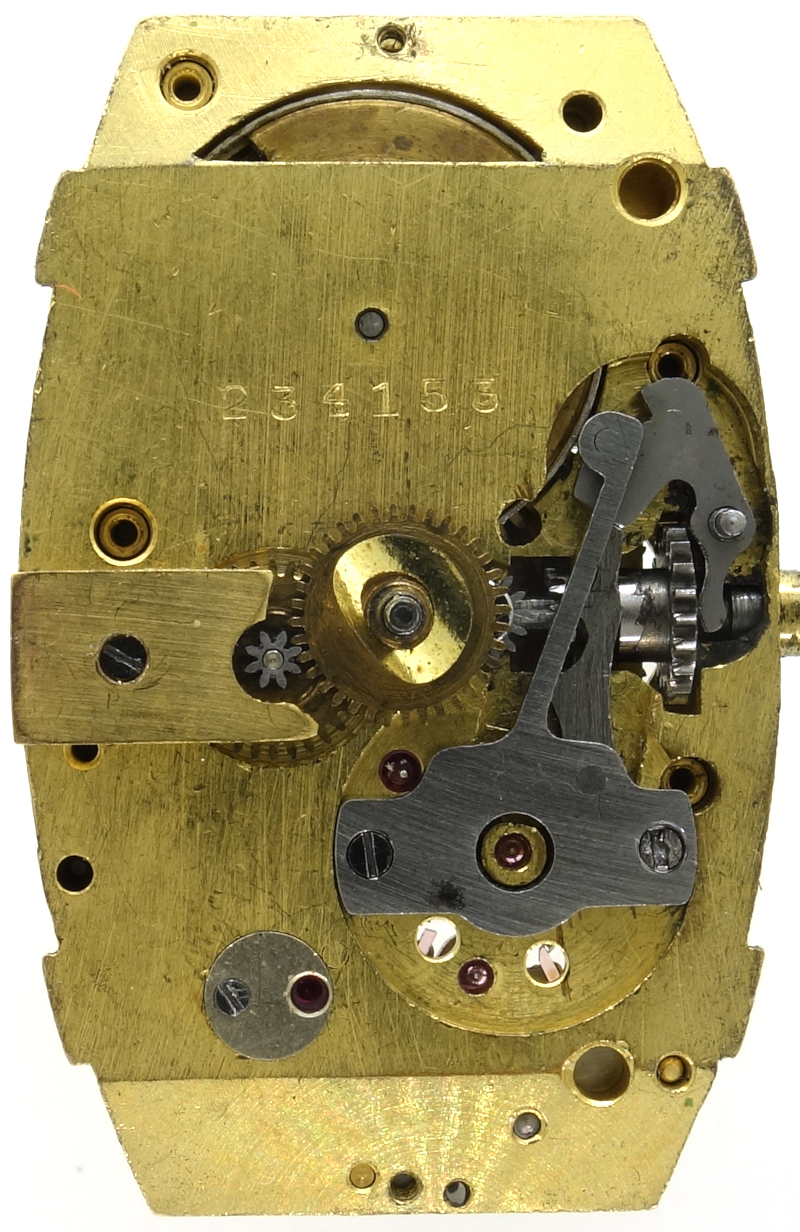
Lip T18: Dial side
On the dial side, the gigantic setting lever spring immediately catches the eye; it is exceptionally robust and therefore practically indestructible. Exemplary!
What is always somewhat surprising about this movement is the position of the decentral seconds indication, because it is located particularly close to the center of the movement.
The thick protective bridge for the intermediate wheel is also somewhat unusual, but this too contributes to the stability and everyday usability of this movement.
In the lab
Timegrapher result
This movement clearly shows signs of wear, both visually and technically. Not least due to the large beat error, the timekeeping performance is far below the potential of this movement, with the defective pallet fork undoubtedly being the biggest contributor to the poor results.| horizontal positions | |||
|---|---|---|---|
| dial up | -3 s/d | 217° | 7.2ms |
| dial down | -11 s/d | 273° | 7.3ms |
| vertical positions | |||
| crown right (12 up) | +30 s/d | 234° | 9.2ms |
| crown up (3 up) | -80 s/d | 229° | 9.0ms |
| crown left (6 up) | -80 s/d | 224° | 7.4ms |
| crown down (9 up) | +90 s/d | 224° | 8.2ms |
Technical data
| Manufacturer: | Lip |
| Caliber: | T18 |
| Size: | 7 3/4 x 11''' (measured: 17,8 x 28,6mm) |
| A/h: | 18000 |
| Number of jewels: | 15 |
| Escapement: | Pallet lever |
| Balance types: | monometallic screw balance (two legs) |
| Shock protection(s): | none |
| Balance bearing / direction hairspring: | Clockwise |
| Moveable stud: | no |
| Adjust mechanism: | Long regulator arm |
| Construction: |
|
| Construction type: | solid construction |
| Winding mechanism: | yoke winding system |
| Setting lever spring: | 2 holes |
| Attachment of setting lever: | screwed |
| Features: |
|
| Production years: | 1935 - 195? |
| References: | Feilner: Bl.13 509 Flume: 1947 134 Jacob: 1942 15054 |
| Inventory number: | 24043 |
Usage gallery
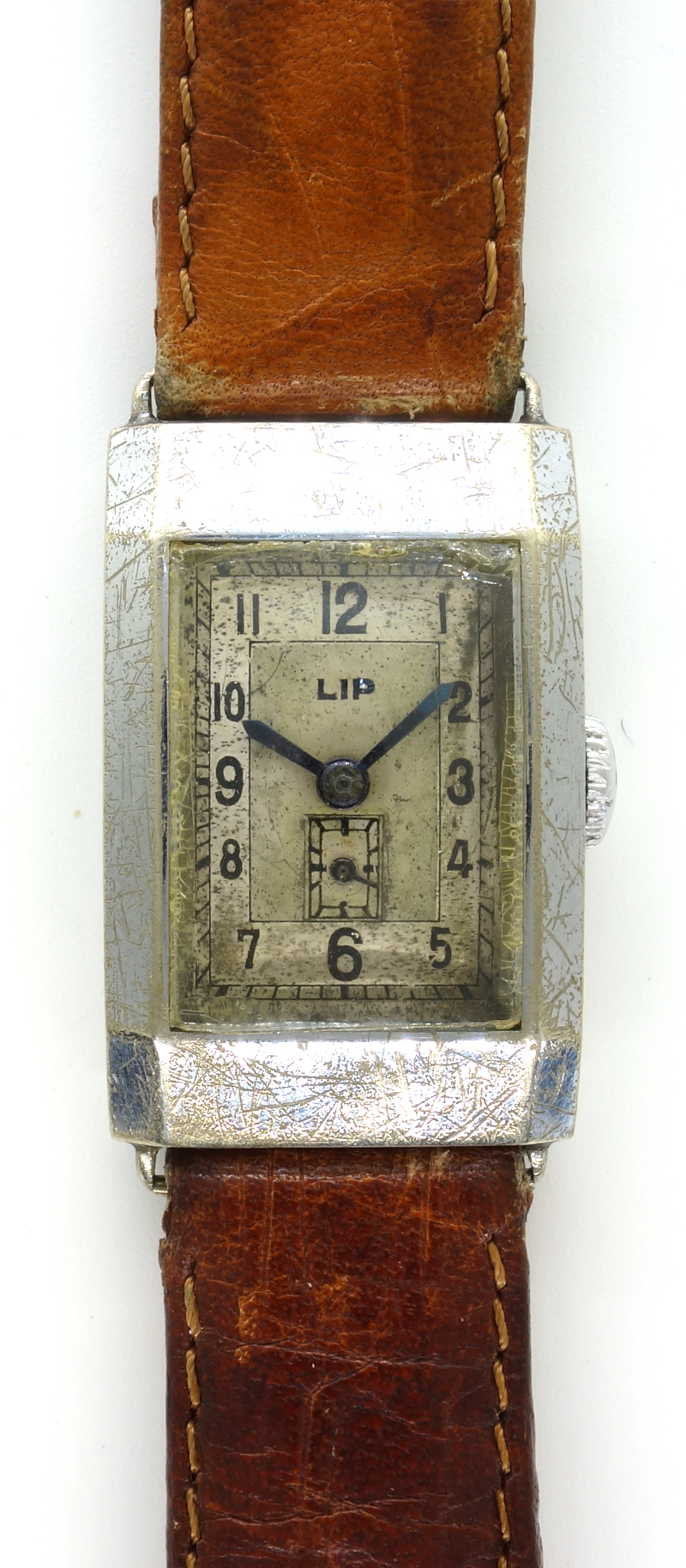
Lip gents watch